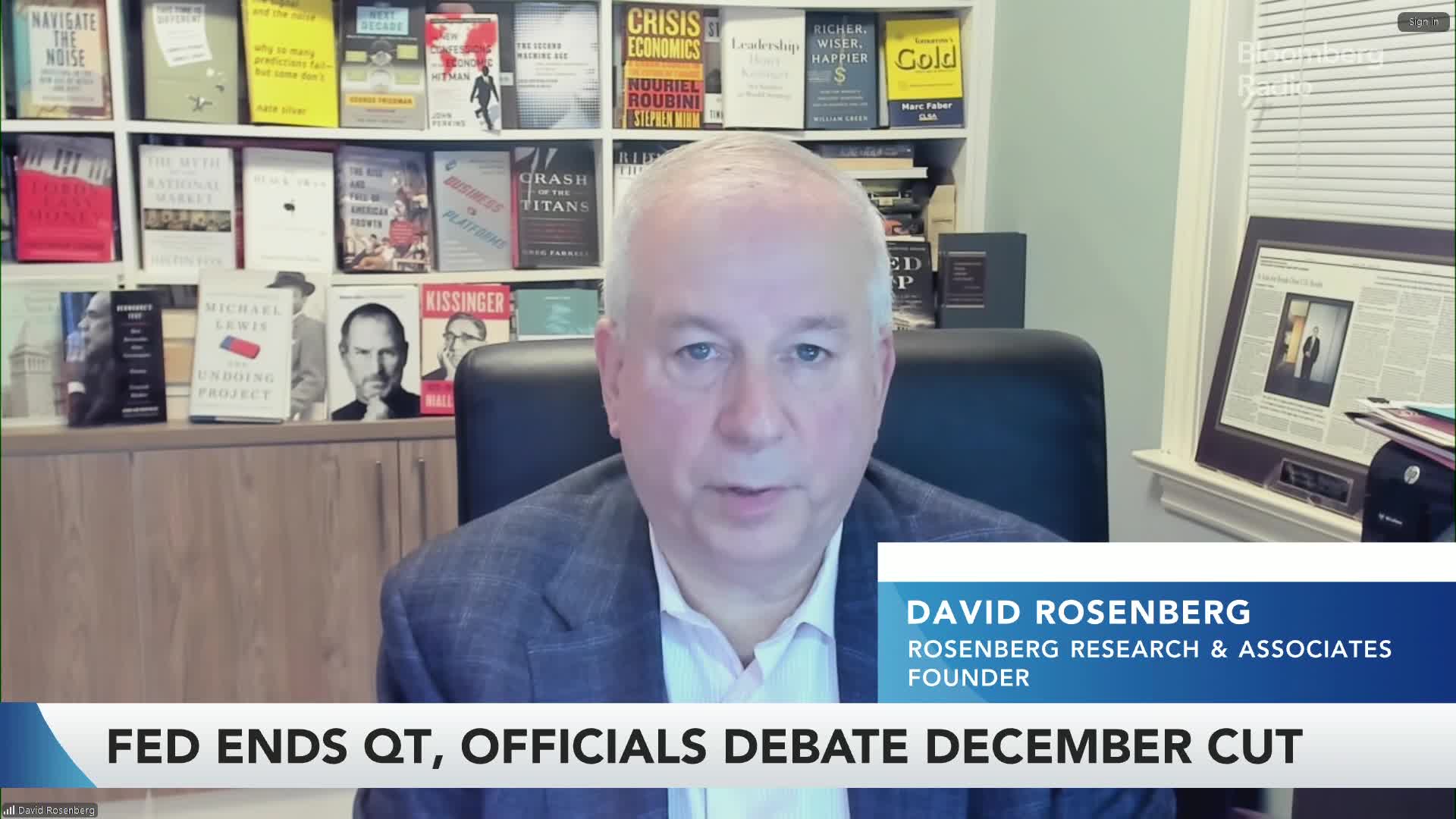
David Rosenberg argues the Fed is materially above a nominal neutral rate he pegs at ~3% (roughly 100bps too tight) amid falling underlying inflation and a rising unemployment trend (now ~4.4% vs FOMC's 4.2% estimate). He expects the policy rate to reach neutral (~3%) by late winter and to trend toward 2–2.5% by end of next year, and forecasts a December rate cut with messaging of further cuts to come; concurrently he highlights weakening consumer fundamentals — real spending up ~2% annualized since April while real disposable income is down ~1% and savings are collapsing — and soft retail/auto data. The combination implies easing policy ahead and upside pressure on risk assets via rate-cut expectations, but rising income weakness and a K-shaped consumer recovery pose downside risks to growth and corporate revenues.
Market structure: A December cut narrative and disinflation bias rewards rate-sensitive, long-duration assets (IG credit, REITs, long tech) and low-cost retailers (WMT) while compressing bank NIMs and cyclical consumer discretionary. Expect 10yr Treasuries to rally 20–80bp if the Fed signals December cuts; a >50bp fall would materially re-rate growth multiples and lift VNQ/TLT but hurt KRE/KBE and bank equities' valuations.
Risk assessment: Tail risks include a policy mistake (Fed too slow → deeper recession) or a shock (commodity spike, geopolitical) that reverses disinflation; both would widen credit spreads >150bp and spike equity volatility. Immediate catalysts: retail sales and payrolls (next 1–6 weeks), FOMC messaging (Dec meeting) — if unemployment breaches 4.7% or core CPI falls below 3.0% expect accelerated cuts through H1 2026.
Trade implications: Tactical winners: long TLT/VNQ/LQD and overweight Walmart/XLP; tactical losers: regional bank ETFs (KRE) and discretionary (XLY) where margins and demand are squeezed. Use options to express asymmetry: buy put spreads on regional banks (3–6 month) and call spreads on TLT or GOOGL LEAPs to leverage lower-rate outcome while capping premium.
Contrarian angles: Consensus assumes one or two cuts priced in; Rosenberg implies multiple cuts and a deeper real-income recession—markets may underprice a multi-cut, multi-quarter disinflation that pushes 10yr below 3.0% and inflates mega-cap multiples. Conversely, bank shorts are crowded and regulatory backstops or faster-than-expected fiscal support could snap them back — size positions accordingly and hedge with volatility buys.
AI-powered research, real-time alerts, and portfolio analytics for institutional investors.
Request DemoOverall Sentiment
moderately negative
Sentiment Score
-0.35
Ticker Sentiment
