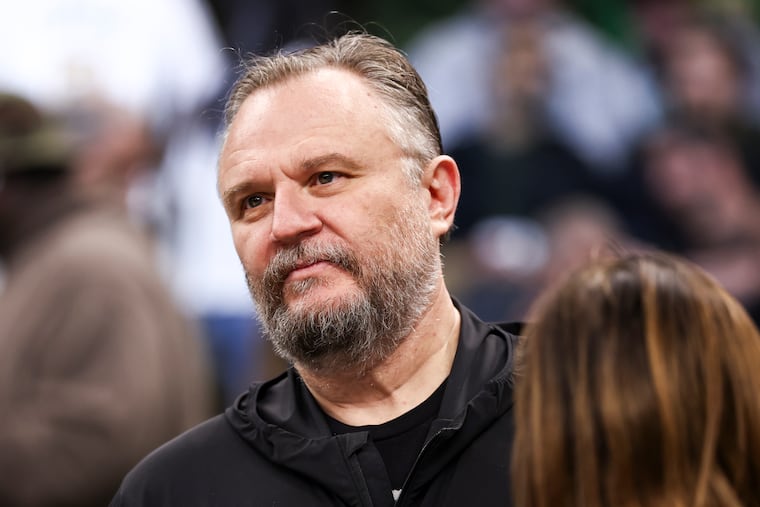
Daryl Morey is departing after six seasons as president of basketball operations for the Philadelphia 76ers, while Nick Nurse will return as head coach and Bob Myers will lead the interim front office search. The move follows a first-round upset of the Celtics and a subsequent sweep by the Knicks, after a 45-37 regular season and a 2024-25 campaign that fell from championship expectations to a 24-58 disaster. The story is primarily a management shakeup with limited direct market impact.
This is less a one-off coaching shakeup than a governance reset after a multiyear capital-allocation failure. In sports-equity terms, the signal is that ownership is now prioritizing process credibility over prior regime continuity, which usually helps stabilize stakeholder sentiment in the medium term even if it creates short-run uncertainty. The market analog is a management change after a deep drawdown: initial relief rallies are common when investors believe a new decision-maker can impose discipline on a previously constrained platform.
The second-order issue is roster optionality. A new front office can more easily reframe the asset base, but it also inherits a classic stranded-capital problem: high fixed payroll, aging star exposure, and limited flexibility if availability risk persists. That means the best path to improvement is not incremental tinkering but one or two asymmetric moves that convert fragile upside into durable depth; if those fail, the organization risks another 12-18 months of narrative drift and fan base erosion.
The contrarian angle is that the prior regime may have been punished for outcomes driven partly by variance and health rather than pure process error. If the replacement is more conservative, the club could actually become less aggressive in asset turnover, reducing near-term upside but improving floor outcomes. In that sense, the dismissal can be read as a signal that ownership is now more sensitive to public accountability than to maximizing expected title probability, which slightly raises the odds of suboptimal but politically safer decisions.
For investors, the key lens is not the team itself but adjacent businesses exposed to local sports enthusiasm and media demand. A credible reset can boost engagement metrics for regional media, arena-adjacent hospitality, and merchandise, but only if the new front office quickly creates a compelling summer narrative. If the search drags or the next hire is underwhelming, the disappointment cycle could deepen and suppress engagement into next season.
AI-powered research, real-time alerts, and portfolio analytics for institutional investors.
Request DemoOverall Sentiment
mildly negative
Sentiment Score
-0.20
