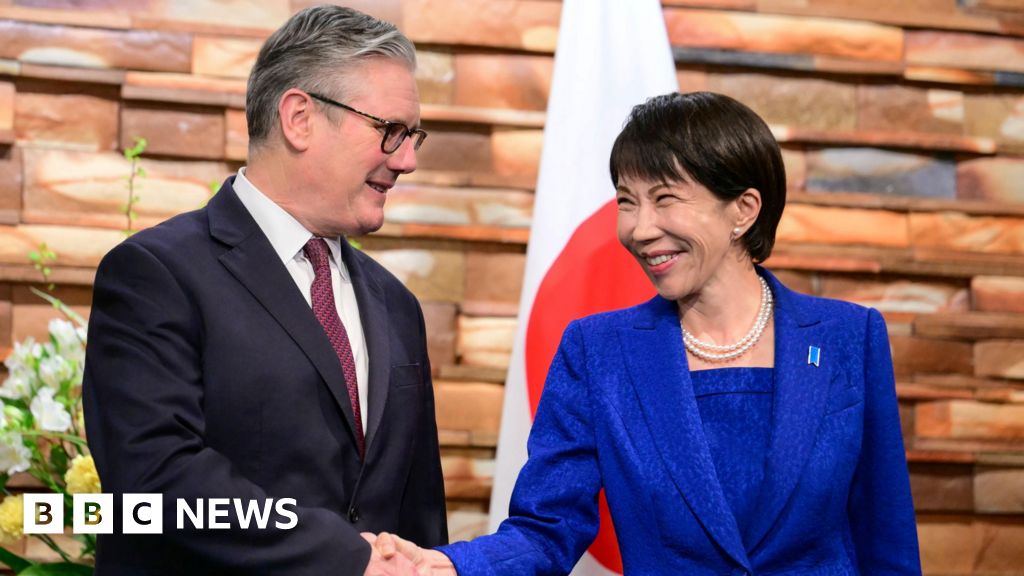
UK Prime Minister Keir Starmer met Japan PM Sanae Takaichi in Tokyo, inviting her to visit the UK pending Japan's snap election and announcing intentions to deepen trade and security ties, including defence cooperation and a trilateral fighter-jet programme with Italy. The visit follows Starmer's China trip that secured £2.2bn in export deals, tariff reductions on whisky and visa-free travel for UK citizens to China, but Takaichi's comments on China-Taiwan tensions inject geopolitical risk that could influence defense contractors, supply-chain policy and investor sentiment toward regional exposure.
Market structure: The UK–Japan rapprochement disproportionately benefits defence primes (BAE Systems - BA.L, Rolls-Royce - RR.L), critical-minerals and processing companies (MP Materials - MP) and premium UK exporters exposed to Japan/Asia (Diageo - DGE.L) via tariff relief and procurement pipelines. Expect 12–36 month demand growth for fighter-related R&D and parts, tightening supply for specialty metals (rare earths, nickel, cobalt) and giving pricing power to vertically integrated miners/processors; shipping/logistics providers also see higher volumes. Cross-asset: stronger defence/industrial demand should be mildly reflationary—supporting industrial commodities (+10–25% idiosyncratic moves possible) and pressuring gilts (basis: +10–30bp over 6–12 months) while FX may see episodic GBP strength vs JPY on positive headlines but JPY safe-haven bids if Taiwan rhetoric escalates.
Risk assessment: Key near-term binary is Japan’s Feb 8 election; if LDP loses, diplomatic momentum and procurement timelines could slip 3–12 months (probability-weighted). Tail risks: rapid Taiwan escalation (low probability, high impact) would invert trades—boost JPY and gold, collapse regional equities; punitive Chinese trade responses remain possible against hawkish Japan/UK rhetoric. Hidden dependencies include UK fiscal capacity to fund defence programs and supply-chain bottlenecks for specialty metals that can turn expected wins into 6–18 month delays. Primary catalysts: Feb 8 election, formal defence contracts (6–24 months), UK budget statements (next fiscal cycle).
Trade implications: Tactical ideas: establish 2–3% long in BA.L (target +15–25% in 9–18 months, 10% stop-loss) and 1–2% long in MP (MP) to play critical-mineral re‑sourcing (target +20–30% in 6–18 months). Buy Diageo (DGE.L) 1–2% ahead of tariff benefits (target +8–12% in 3–6 months); implement a 9–12 month call spread on BA.L (ATM to +25% strike) to limit capital and skew payoff. Use a relative pair: long BA.L vs short FTSE 100 ETF (e.g., ISF.L) 1:1 to isolate defence outperformance versus broad UK market.
Contrarian angles: The market underestimates speed at which Japan-UK defence supply-chains can be onshored—if procurement announcements arrive within 6 months, small caps in UK sub‑suppliers could rerate >30%. Conversely consensus may be underpricing election risk; if LDP loses or China retaliates, JPY could appreciate >3% in days and commodity/UK-export trades quickly unwind. Historical parallel: post-2010 US‑Japan defence coordination lifted primes ~15–25% within 12 months but with 20–30% volatility spikes; hedge with JPY call options or 10% cash buffers.
AI-powered research, real-time alerts, and portfolio analytics for institutional investors.
Request DemoOverall Sentiment
mildly positive
Sentiment Score
0.25
