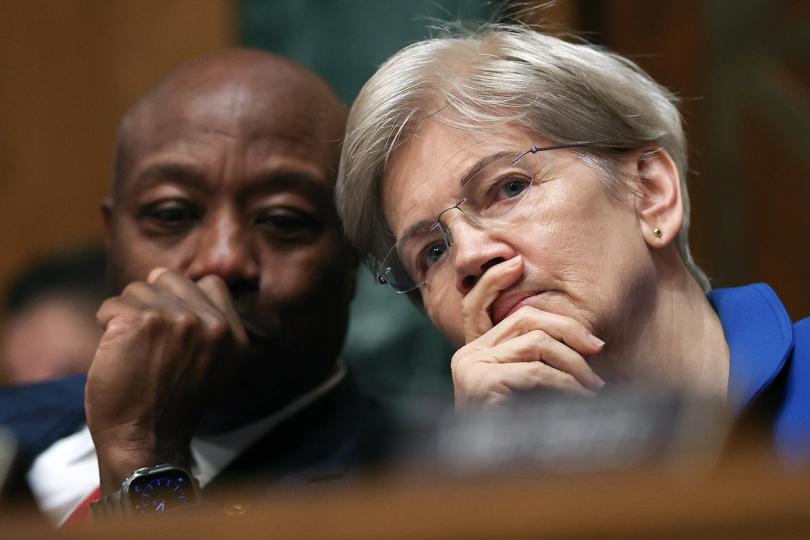
The Clarity Act advanced out of the Senate Banking Committee by a 15-9 vote, with bipartisan support including Democratic Senators Ruben Gallego and Angela Alsobrooks. The bill now moves to the Senate floor, where negotiators are expected to reconcile it with the Senate Agriculture Committee's version. The legislation is aimed at regulating digital assets and addressing consumer protection and deposit-flight concerns, making it a meaningful policy development for crypto and banking markets.
The important signal is not the committee vote itself; it is that the emerging legislative architecture is moving toward a compromise that likely preserves crypto market access while adding a clearer banking perimeter. That tends to favor large, regulated intermediaries over fringe venues because compliance-heavy firms can absorb licensing, custody, and reporting costs more easily than smaller competitors. In practice, this is a relative winner for exchange/prime brokerage models with institutional distribution and a relative loser for less-capitalized platforms that compete on regulatory arbitrage. The second-order issue is deposit migration. If the eventual bill narrows the ability of banks to market certain digital-asset services without explicit safeguards, the immediate beneficiary is not necessarily crypto-native balance sheet growth but stablecoin and off-balance-sheet wallet usage, which reduces direct deposit retention for community and regional banks. That creates a medium-term headwind for banks that rely on low-cost deposits and have weaker fee diversification, while large money-center banks are better positioned to reprice and cross-sell through custody and payments franchises. For markets, the catalyst path matters more than the policy headline: floor debate and conference-style negotiation can still dilute or delay the bill for months, and any fresh concern around deposit flight can reintroduce bank lobby pressure. The risk to the bullish crypto read is that broader regulation can be interpreted as legitimizing incumbents without meaningfully expanding retail adoption, limiting upside to a rerating of multiples rather than a step-change in volumes. Conversely, if the final text is perceived as operationally workable for banks, the winning trade is a slow-burn reacceleration in institutional flows, not an immediate speculative squeeze. The consensus likely underestimates how much of the value accrues to infrastructure providers rather than token prices. Clearer rules typically compress dispersion: top-tier exchanges, custody providers, and payments rails gain share while weaker platforms lose it. That argues for expressing the view through the highest-quality beneficiaries and against the most deposit-sensitive lenders, rather than taking a broad crypto beta bet.
AI-powered research, real-time alerts, and portfolio analytics for institutional investors.
Request DemoOverall Sentiment
neutral
Sentiment Score
0.15
