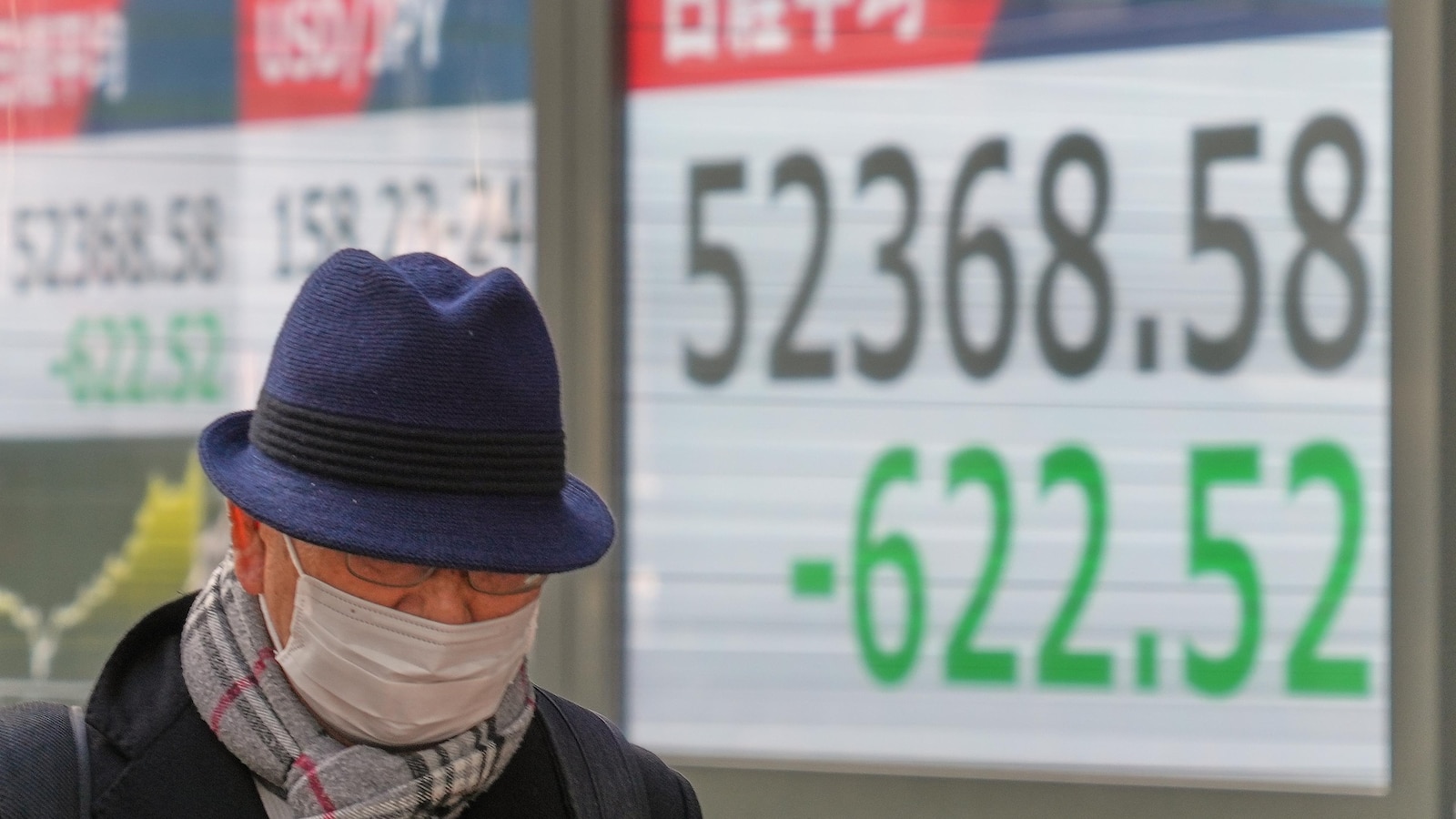
Global markets moved into risk-off mode as President Trump’s tariff threats over Greenland and announced 10% tariffs on multiple European countries stoked investor unease ahead of his Davos speech and next week’s Fed meeting. Gold jumped 1.7% to breach $4,800 as a safe-haven, U.S. futures were slightly higher (S&P +0.3%, Dow +0.2%) after steep U.S. losses (S&P -2.1%, Dow -1.8%, Nasdaq -2.4%), while Asian markets were mixed (Hang Seng +0.4%, Shanghai +0.1%, Nikkei -0.4%). Market-sensitive indicators also moved: 40-year JGB yield eased to 4.095% from 4.22%, Brent traded at $64.22/bbl, U.S. crude at $59.80/bbl, and USD/JPY ~158.08.
Market structure: Immediate winners are traditional safe-havens (gold, long-duration Treasuries) and volatility sellers covering; losers are large exporters and cyclical industrials (auto suppliers, heavy machinery) that face tariff risk and potential EU retaliation. Pricing power shifts toward domestic producers in protected sectors and miners; global supply chains (autos, components) face margin compression if tariffs are implemented, pressuring FY+1 EBIT by mid-single digits for exposed names.
Risk assessment: Tail risks include a rapid escalation to tit-for-tat tariffs with the EU (low probability but GDP shock >1% globally) and a disorderly JGB/yield repricing in Japan from political fiscal promises—both could spike global equities vol >30% in 1–3 months. Near-term (days–weeks) drivers are Davos comments and next week’s Fed meeting; medium-term (1–6 months) risk centers on snap election outcomes in Japan and EU trade-policy responses; long-term (6–24 months) is supply-chain re-shoring or contractual repricing.
Trade implications: Tactical plays favor 3–6 month long gold exposure and long-duration Treasuries vs short cyclicals; buy protective put exposure on high-beta tech (NVDA, AAPL) sized 1–2% portfolio each to hedge a risk-off shock. Consider pair trades: long TLT (3% allocation) / short XLI (3%) for 1–3 months; use options (buy 10–20% OTM puts, 6–12 week expiries) on NVDA/AAPL to limit cost while capturing downside if tariffs/retaliation hit earnings.
Contrarian angles: Consensus overstates permanent damage — past tariff spats (2018) produced sharp but short-lived hits to cyclicals while dominant large-cap tech recovered within quarters. Gold at record and immediate rush to safety may be overbought—if Fed signals dovish hold and risk sentiment stabilizes, expect mean reversion in gold (10–15%) and re-rating in NVDA/AAPL. Unintended consequence: persistent safe-haven flows could steepen real yields and squeeze banks’ NII dynamics; watch curve moves as a tradeable signal.
AI-powered research, real-time alerts, and portfolio analytics for institutional investors.
Request DemoOverall Sentiment
moderately negative
Sentiment Score
-0.45
Ticker Sentiment
