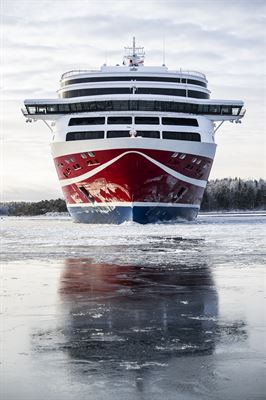
Viking Line reported 4,608,573 passengers in 2025 (down 0.8% vs. 2024) while boosting cargo to a record 139,484 units (≈+4% YoY) and increasing market share on key Helsinki–Stockholm and Helsinki–Tallinn routes (Helsinki–Stockholm passengers +12%, market share 47%). The company transported 509,634 cars, saw Birka Gotland passenger volumes rise 30% to 570,513, and scaled biogas use tenfold to ~6,000 tonnes, reducing vessel greenhouse gas emissions by more than 60,000 tonnes. Viking Line also unveiled the Helios electric passenger/car ferry concept targeting a potential green shipping corridor between Helsinki and Tallinn in the early 2030s, reinforcing its operational and sustainability positioning.
Market structure: Viking Line’s 47% share on Helsinki–Stockholm and a record +4% cargo volume (139,484 units) shift pricing power toward incumbent short-sea ro-ro operators and logistics integrators that can offer carbon-neutral options. Immediate winners: ferry operators with route density and cargo contracts, marine equipment suppliers for electrification/shore power (e.g., electric drivetrain suppliers). Losers: traditional marine bunker suppliers and legacy shipyards that can’t retrofit efficiently; expect downward pressure on marine bunker demand over 3–7 years as biogas/LNG/electric uptake rises.
Risk assessment: Tail risks include an EU regulatory acceleration (stricter ETS or zero-emission corridors) that forces accelerated capex, and operational grid/charging bottlenecks for electric ferries—both could double near-term capex vs. current plans. Short-term (0–12 months) demand is stable; medium (1–3 years) depends on subsidy clarity and shipyard capacity; long-term (3–10 years) favors electrified/biogas fleets if Helios-like projects secure financing and grid agreements. Hidden dependencies: port electrification, green hydrogen/biogas supply contracts and CCS credits availability.
Trade implications: Favor equities and suppliers enabling the green transition: selective long exposure to regional ferry players with cargo franchises and to industrials supplying marine electrification; hedge with short exposure to bunker-refining margins or legacy cruise operators with weak cargo exposure. Use options to express asymmetric upside on electrification suppliers while limiting drawdown if projects delay. Rebalance travel/leisure cyclical exposure toward logistics and industrials over 6–18 months.
Contrarian angles: The market underestimates implementation friction—grid upgrades, financing and shipyard bottlenecks could push large-scale electrified ferries to late 2030s, not early 2030s; that favors suppliers with retrofit expertise vs. pure-play newbuild builders. Don’t pay up for ESG narratives alone: require binding offtake/subsidy contracts (threshold: >=50% secured project financing or long-term charters) before assigning >15% upside to a company valuation.
AI-powered research, real-time alerts, and portfolio analytics for institutional investors.
Request DemoOverall Sentiment
moderately positive
Sentiment Score
0.48
