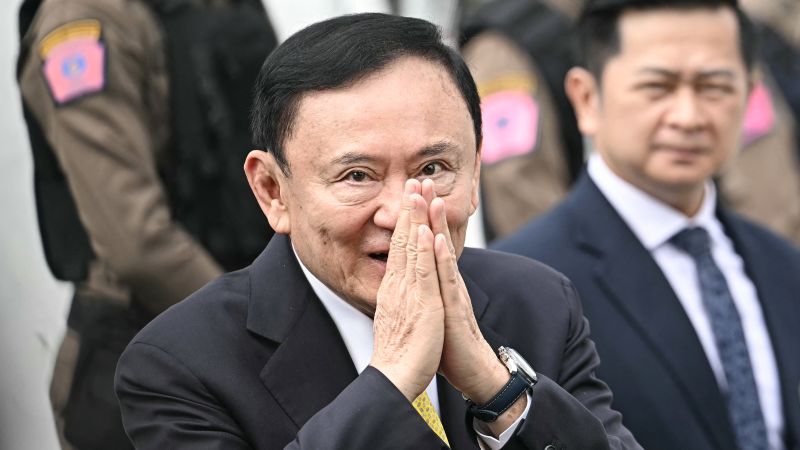
Thailand's Supreme Court has ordered former Prime Minister Thaksin Shinawatra to serve a one-year prison sentence, ruling his previous prolonged hospital stay was unlawful and did not count as time served. This decision directly challenges the perception of special treatment for the influential figure and signals a significant development in the ongoing power dynamics between the Shinawatra dynasty and Thailand's establishment. Coupled with the recent ousting of the Shinawatra family's Pheu Thai party from government and the appointment of a new prime minister, the ruling suggests a potential weakening of the family's long-dominant political machine and could impact future political stability in the country.
Thailand's political landscape is undergoing a significant realignment, underscored by the Supreme Court's order for former Prime Minister Thaksin Shinawatra to serve a one-year prison sentence. The court's ruling that his extended hospital stay was unlawful and did not constitute time served directly challenges the narrative of a negotiated lenient return from exile, signaling a harder line from the country's conservative establishment. This legal blow is compounded by recent political defeats for the Shinawatra dynasty; his daughter, Paetongtarn Shinawatra, was recently removed as Prime Minister, and their Pheu Thai party was subsequently ousted from government. The installation of a new Prime Minister, Anutin Charnvirakul, breaks a two-decade pattern of rule dominated by either the Shinawatras or the military. Collectively, these events indicate a material weakening of the Shinawatra family's political machine, creating a period of heightened domestic political uncertainty and governance shifts, consistent with the moderately negative sentiment and elevated country risk profile.
AI-powered research, real-time alerts, and portfolio analytics for institutional investors.
Overall Sentiment
moderately negative
Sentiment Score
-0.50
