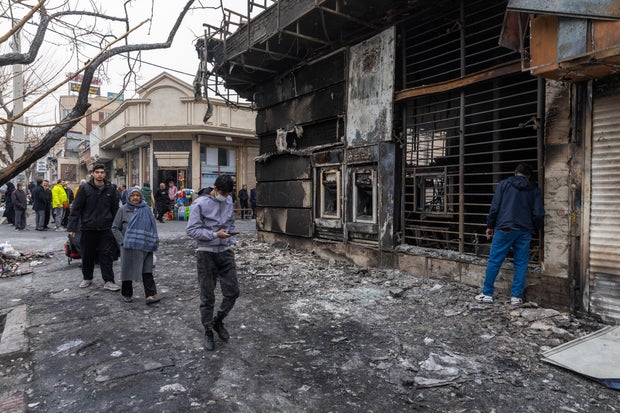
Multiple sources, including activists and an internal contact, allege a government crackdown in Iran has killed at least 12,000 and possibly up to 20,000 people amid nationwide protests over rising cost of living; CBS verified video shows at least 366 bodies at a Tehran-suburb morgue. The communications blackout, divergent official counts (Iran/Reuters ~2,000), and public statements by U.S. and U.K. officials raise acute geopolitical risk for emerging markets and regional stability, with potential implications for sanctions, energy-market volatility and higher investor risk premia.
Market structure: Geopolitical shock favors defense (LMT, RTX, LHX), satellite/secure-communications (IRDM, VSAT) and energy majors (XOM, CVX, XLE) via a near-term risk premium in Brent; losers are EM equities/bonds (EEM, EMB), regional airlines (JETS) and tourism-related sectors as credit spreads widen and FX weaken. Expect a 5–15% bump in oil risk premium if sanctions or shipping disruptions persist >30 days, gold to outper-form cash by ~3–8%, and USD/Treasuries to tighten as safe-haven flows push 2–10% moves in EM FX and 20–150bp moves in sovereign CDS depending on severity.
Risk assessment: Tail scenarios include a limited US kinetic strike (<10% probability in 0–3 months) with outsized market shocks, or a broader Gulf escalation (20–30% probability over 6–12 months) that could remove 0.5–2.0 mbpd from markets temporarily. Immediate (days): liquidity and volatility spikes in EM; short-term (weeks–months): EM credit spreads +50–200bp and commodity-driven inflationary impulses; long-term (quarters+): re-rating of defense/cybersecurity and structural EM capital flight if sanctions deepen. Hidden dependency: shipping insurance and re-routing costs could amplify oil price moves independent of physical supply loss.
Trade implications: Tactical moves favor 2–3% portfolio allocation to top-tier defense (split LMT/LHX) within 2–6 weeks, 1–2% allocation to GLD and a 3-month GLD call spread for convexity, and a 1–2% directional Brent exposure (BZ/USO or XLE) via 1–3 month call spreads sized to risk budget. Hedge EM downside by trimming EEM exposure ~30% over 7 days and buying 3-month ATM puts on EEM/EMB equal to 0.5–1% notional; increase 7–10yr Treasury exposure (IEF) by 1–2% as interim ballast.
Contrarian angles: Consensus will crowd into defense/oil; risks are overpaying if protests cause rapid regime collapse and normalization within 3–6 months (historical parallel: Arab Spring oil spikes faded in 3–6 months). Look for selective, higher-beta buys in EM energy-services names with <10% Iran revenue if prices draw down 20–30%; conversely, avoid levering long cyclicals — volatility mean-reverts, so consider selling front-month oil/defense vol after 8–12 weeks if conflict does not materialize further. Unintended consequence: US intervention could trigger >20% oil spike and global growth shock, so cap gross exposure and size tail protection.
AI-powered research, real-time alerts, and portfolio analytics for institutional investors.
Request DemoOverall Sentiment
strongly negative
Sentiment Score
-0.70
