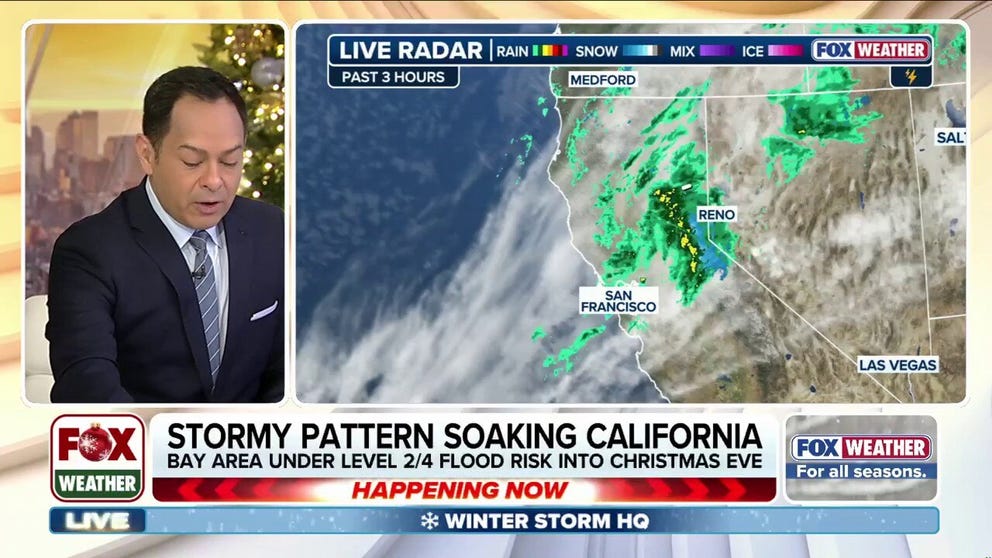
An atmospheric river has dumped up to nearly a foot of rain in parts of Northern California, causing at least one death, widespread flooding, multiple water rescues and a shutdown of US-101 north of Loleta; SFO flights were halted and further delays are expected at SFO and LAX. Forecasts call for a second round of rain with San Francisco seeing 3–5 inches through Friday and the Los Angeles metro under a Level 3 flash‑flood risk with 5–8 inches possible and rain rates near an inch per hour, raising mudslide and debris‑flow risks around wildfire burn scars; wind gusts up to 80 mph and feet of Sierra snow with mountain pass closures are also expected. These conditions present localized operational and infrastructure risks for airlines, road transport, emergency services and insurers over the holiday period.
Market structure: Short-term winners are construction/materials suppliers (aggregate, asphalt, concrete — VMC/MLM) and spot energy (natural gas) as heating and restoration demand rises; losers are airlines (AAL/DAL/UAL/LUV), time-sensitive logistics (JBHT, UPS, FDX) and property insurers (ALL, TRV) facing concentrated coastal/burn-scar claims. Expect 1–3 week spikes in aggregate and gas prices (roughly +5–15%) and 5–10% negative P/L pressure on airline daily revenue per available seat mile (RASM) during holiday cancellations. Fixed-income flows should push safe-haven Treasuries down 10–25 bps on flight-to-quality while California muni spreads can widen 10–40 bps contingent on insured-loss estimates.
Risk assessment: Tail risks include multi-week closure of US-101 or a major dam/debris-flow catastrophe causing >$1bn insured losses and prolonged supply-chain delays; probability low (<10%) but high impact. Immediate horizon (days): travel disruption and local logistics stoppages; short-term (weeks–months): insurance loss recognition, municipal fiscal stress, construction procurement cycles; long-term (quarters+): insurance repricing, capital allocation to hardening infrastructure. Hidden dependencies: burn-scar correlated losses amplify claims concentration and contractor capacity limits create supply bottlenecks; FEMA declarations and Reinsurance treaty retentions will be key catalysts.
Trade implications: Tactical trades: buy 2–6 week protective puts on major airlines or sell 1–2 week call spreads on airline daily revenues; go long 1–3 month natural-gas exposure (UNG or gas futures) sized 1–2% of portfolio; establish 1–2% longs in VMC/MLM via 3–6 month call spreads to capture rebuilding demand. Rotate portfolio overweight to materials and short-term utility/service contractors, underweight airlines/logistics for 2–8 weeks; enter immediately for weekly option plays, hold materials positions 3–6 months.
Contrarian angles: Consensus focuses on immediate travel pain but often overprices sustained insurance/credit hits — past atmospheric rivers caused transient airline/airport drawdowns (5–12%) that mean-reverted in 4–8 weeks while materials outperformed as municipal spend kicked in. A sharp pullback in airlines >15% could be a mean-reversion buy; conversely, if insured-loss estimates breach $1bn quickly, insurers/reinsurers could be underpriced on the short side. Watch FEMA aid and reinsurance bulletin updates as potential reversals.
AI-powered research, real-time alerts, and portfolio analytics for institutional investors.
Request DemoOverall Sentiment
moderately negative
Sentiment Score
-0.45
