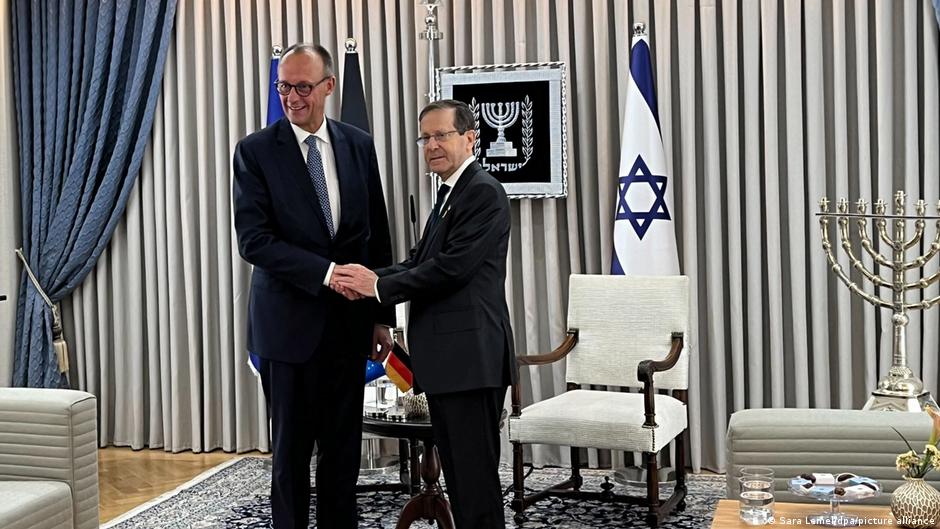
German Chancellor Friedrich Merz conducted his first official trip to Jordan and Israel, meeting King Abdullah II and President Isaac Herzog and planned talks with Prime Minister Benjamin Netanyahu, reaffirming Germany’s commitment to Israel after the October 7, 2023 attacks. Merz acknowledged dilemmas over Israel’s Gaza operations, referenced a since‑lifted partial halt on weapons deliveries, backed a two‑state solution and US President Trump’s Gaza plan, and praised Jordanian mediation; Herzog highlighted German deployment of the Israeli Arrow 3 missile‑defense system. The visit underscores continuity in bilateral defence and diplomatic ties amid a conflict that has killed over 70,000 Palestinians, but it is unlikely to materially move broad markets beyond defense contractors and regional risk premia in the near term.
Market Structure: Germany's rapprochement with Israel (lifted partial arms halt, talk of Arrow‑3 deployment) structurally benefits European and Israeli defense primes (RHM.DE, HAG.DE, ESLT) and adjacent systems integrators; expect a 10–30% re‑rating over 6–12 months if procurement pipelines reopen. Losers in the near term are firms vulnerable to renewed export controls or reputational risk (civilian contractors tied to Gaza operations) and any European exporters hit by renewed sanctions. Commodity demand impact is conditional: a limited diplomatic thaw is neutral for oil; regional escalation would flip that immediately.
Risk Assessment: Tail risks include regional escalation (Iran/Hezbollah) that could push Brent >$100 within weeks and equities down 8–15%, or a German domestic reversal reinstating export limits that trims 15–25% off projected defense revenue — both low probability but high impact. Immediate (days): muted moves; short (weeks–months): defense equities react to procurement signals and budget guidance; long (quarters+): higher German fiscal/defence spending could lift yields (German 10y +10–30bp) and re‑allocate EU defense supply chains. Hidden dependency: EU internal politics — SPD/Greens pushback could revoke practical gains even after diplomatic statements.
Trade Implications: Tactical longs in RHM.DE (2–3% portfolio), ESLT (1.5–2%), and HAG.DE (1–2%) with 6–12 month horizons; use 6‑month 10–15% OTM call options sized at 30–50% of equity positions to skew payoff. Hedge geopolitical tail risk with a small Brent 3‑month 90/110 call spread (0.5–1% notional) and reduce German sovereign duration by trimming 30–50% of Bund exposure or shorting 10‑year Bund futures.
AI-powered research, real-time alerts, and portfolio analytics for institutional investors.
Request DemoOverall Sentiment
neutral
Sentiment Score
-0.10
Contrarian Angle: Consensus focuses on politics and optics, underweighting procurement mechanics — supply‑chain lock‑ins (interoperability, Arrow‑3 integration) create durable revenue streams for niche suppliers that markets may underprice. Conversely, odds of a German domestic policy reversal are material; crowding into defense longs without stop losses or hedges risks a 15–25% drawdown if export rules snap back.
