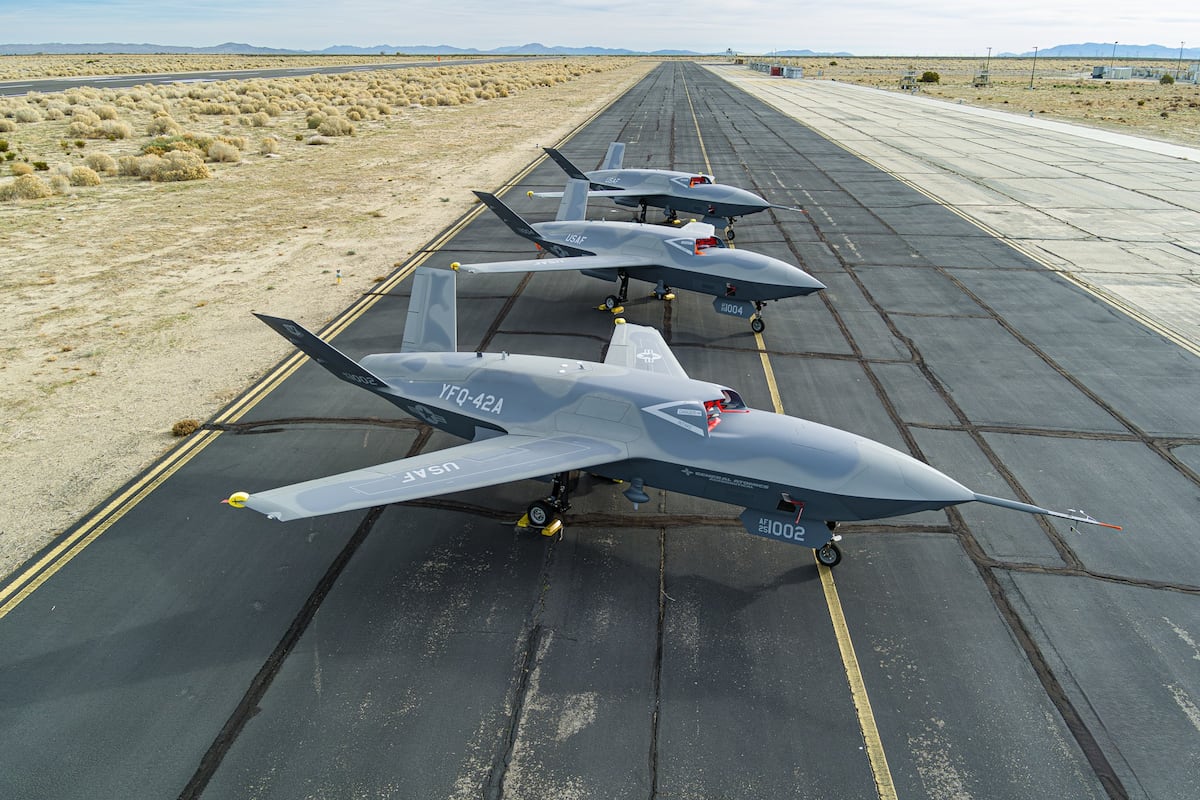
The U.S. Air Force successfully integrated government-owned third-party autonomous software into two prototype collaborative combat aircraft (General Atomics' YFQ-42A and Anduril's YFQ-44A) using the Autonomy Government Reference Architecture (A-GRA), validating a modular, vendor-agnostic approach that could accelerate software deployment across platforms. The service — which contracted the two firms in 2024 and began ground tests in spring 2025 with flight tests later that year — aims to field about 1,000 CCAs for strike, reconnaissance, EW and decoy roles; General Atomics reported a >4-hour semiautonomous mission using Collins Aerospace’s Sidekick autonomy. The milestone reduces vendor lock-in risk, strengthens a competitive ecosystem for autonomy algorithms, and is a strategic positive for contractors supplying compliant platforms and mission software.
Market structure: Immediate winners are avionics/software integrators and middleware (RTX/Collins explicitly), AI autonomy vendors, sensors and weapons suppliers; losers over 2–5 years are vertically integrated airframe vendors that relied on proprietary stacks. Decoupling mission software via A-GRA commoditizes hardware interfaces, increasing price competition on platforms while concentrating pricing power in top-tier algorithms and compute providers (expect a 10–30% revenue premium for certified autonomy software suppliers over hardware-only vendors). Cross-asset: modestly positive for USD and long-term Treasury yields if DoD capex rises; small positive for NVDA-like AI chip names and for commodity demand for munitions/sensors.
Risk assessment: Tail risks include a regulatory moratorium on lethal autonomous weapons or a high-profile autonomy failure/cyber incident that triggers contract freezes — low probability but could knock 20–40% off small-cap defense software names. Time windows: days — headline-driven knee-jerk moves; weeks–months — flight-test results and FY budget language; years — production ramp to 1,000 CCAs (2030+). Hidden dependencies: chip supply (NVDA, AMD), classified certification timelines, export controls. Key catalysts: A-GRA certification, congressional hearings, next tranche of CCA awards in 3–12 months.
Trade implications: Consider a 2–3% long in RTX (ticker: RTX) sized to portfolio for 6–12 months; implement a 6-month call spread (buy ATM, sell +15% OTM) sized 1% NAV to cap cost. Pair: long RTX + LHX (L3Harris) vs short BA (Boeing) 1:1 for 3–9 months to express defense over commercial aerospace. Tactical hedges: buy 9–12 month XAR 10% OTM puts (~0.5% NAV) against small-cap supplier idiosyncratic risk. Enter on ≤5% pullback or after next positive flight-test milestone (2–8 weeks); take profits at +20–30% or on contract award.
Contrarian angles: Market may underprice commoditization — hardware OEM margins could compress 5–10% by 2028 as software becomes the value center; conversely, software integrators not yet public (or small-cap suppliers) could rerate sharply if they win A-GRA certifications. Historical parallel: open mission systems adoption in the 2010s reallocated profits to middleware over airframes. Unintended consequence: rapid multi-vendor integration increases cyber risk — favor names with proven security pedigrees (RTX, LHX) and size options hedges accordingly.
AI-powered research, real-time alerts, and portfolio analytics for institutional investors.
Request DemoOverall Sentiment
mildly positive
Sentiment Score
0.30
Ticker Sentiment
