
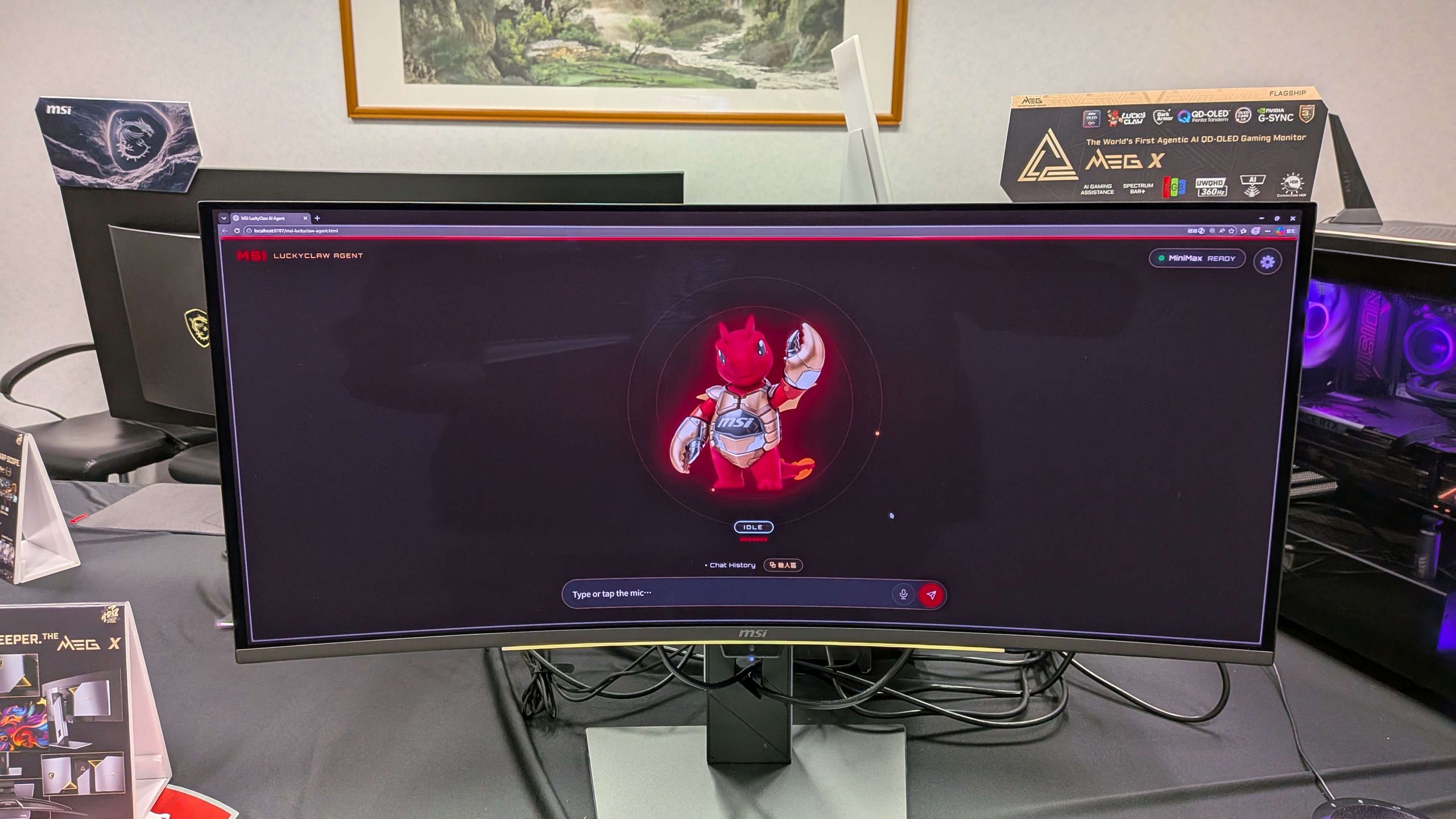
MSI unveiled the $1,599 MEG X, billed as the 'world's first agentic AI monitor,' a 34-inch 5th-gen QD-OLED ultrawide with 3440x1440 resolution at 360Hz and 0.03ms response time. The monitor adds AI features including AI Super Resolution, AI Care Sensor, and a voice-driven OSD control feature, though the article is skeptical about their practical value. The piece is largely a product preview and commentary, with limited near-term market impact.
The meaningful signal here is not AI branding on a monitor; it is the extension of software-defined control into a peripheral that has historically been awkward to manage. If users can change display settings from within Windows, the monitor becomes a more visible endpoint for value-added software, and that shifts pricing power away from pure panel specs toward ecosystem and UX. That favors vendors with tighter hardware-software integration and enough brand pull to monetize premium features, while commoditized ODMs risk being forced into a race to the bottom on panel quality alone.
For Intel, the direct impact is small, but the second-order read-through is better than it first appears. “AI” at the edge here is not training-heavy compute; it is lightweight inference and device control, which is a friendlier use case for Intel’s integrated graphics, NPUs, and Windows PC adjacency than it is for discrete GPU narratives. If this category gains traction, it reinforces the broader OEM message that AI features must show up in consumer hardware in visible, low-friction ways — a subtle tailwind for PC refresh sentiment over the next 2-4 quarters.
The bigger investment question is whether this is an early sign that monitor refresh cycles can be pulled forward by feature creep, or whether this is just a high-end halo product with limited unit economics. My base case is the latter: premium monitor demand can absorb incremental software features, but mainstream adoption will require the value proposition to be obvious and non-gimmicky. The risk to the bullish read is that AI labeling becomes a margin-dilutive marketing tax, with buyers rejecting price increases unless the feature set materially improves usability.
Contrarianly, the market may be underestimating how annoying OSD friction is at scale. A tiny improvement in setup and calibration can matter disproportionately in offices, streaming, and enthusiast gaming, especially if it reduces support burden and returns. If OEMs standardize this control layer, the long-term winner may be the monitor brands that own the user interface, not the ones with the best panel supply.
AI-powered research, real-time alerts, and portfolio analytics for institutional investors.
Request TrialOverall Sentiment
neutral
Sentiment Score
0.15
Ticker Sentiment
