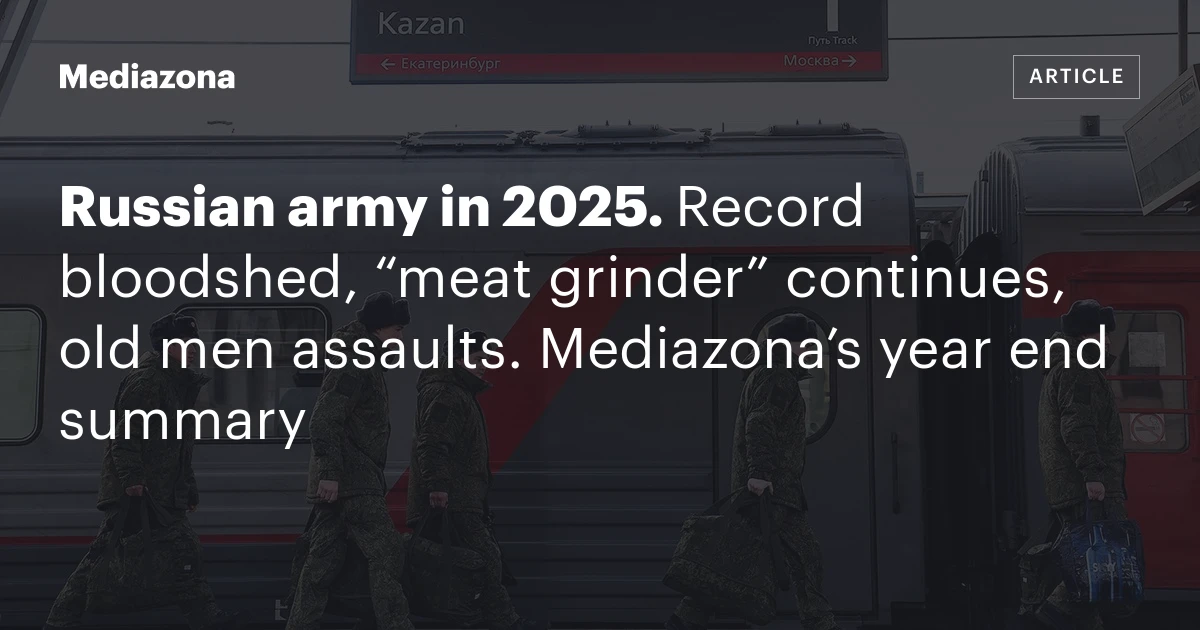
Independent analysis shows 2025 is the deadliest year of the invasion to date, with over 156,000 confirmed killed since the war began and excess-mortality data implying at least 100,000 Russian military deaths in 2024 alone and a projected higher toll for 2025; recruitment is roughly 30,000 per month but is only marginally replacing losses. The report documents a tactical shift toward conserving armor and using high-attrition infantry infiltration, an aging volunteer force (most frequent ages 46–52), widespread court-ordered death declarations (≈90,000 lawsuits since mid-2024) and mass deletion of missing/dead case files across regional courts, underscoring deteriorating military capacity and reduced transparency with implications for political risk and investor assessment of Russia and related emerging-market exposures.
Market structure: The steep rise in Russian frontline casualties and tactics conserving armor shifts demand toward munitions, electronic warfare, loitering munitions, small-arms ammunition and contractor logistics rather than tanks. Expect multi-year uplift in Western defense budgets; a 10–25% incremental procurement cycle for precision munitions and drones in EU/US suppliers over 12–36 months is plausible, tightening supply and raising pricing power for makers of rockets, mortar rounds and counter-drone systems.
Risk assessment: Tail risks include a sudden escalation (NATO direct support expansion or expanded sanctions) or a negotiated pause; both would re-price energy and defense differently. Near term (days–weeks) volatility spike risk to oil, gas, RUB and EM credit; medium term (3–12 months) widening of EM sovereign spreads and sustained outperformance in defense equities; long term (12–36 months) structural reallocation of European budgets to defense.
Trade implications: Tactical trades favor long defense equities/ETFs (ITA, XAR, LMT, NOC) and selective energy exposure to Brent/TTF via futures or ETFs (BNO, XLE) with volatility protection via short-dated put spreads. Short Russian exposure (RSX, RUB forwards) and long gold (GLD) or VIX call spreads as insurance are warranted while monitoring sanctions/litigation flows that can abruptly delist or freeze assets.
Contrarian angles: Consensus assumes Russia’s material depletion forces Western fatigue; the hidden effect is chronic demand for Western munitions and logistics services that benefits mid-cap specialized suppliers (Olin OLN for propellants, ATK suppliers) more than large platforms. If Brent falls below $70 for 30 days or NATO fails to approve major packages in 60 days, rotate back from energy into cyclicals; otherwise maintain overweight defense and ammo specialists for 12–24 months.
AI-powered research, real-time alerts, and portfolio analytics for institutional investors.
Request DemoOverall Sentiment
strongly negative
Sentiment Score
-0.75
