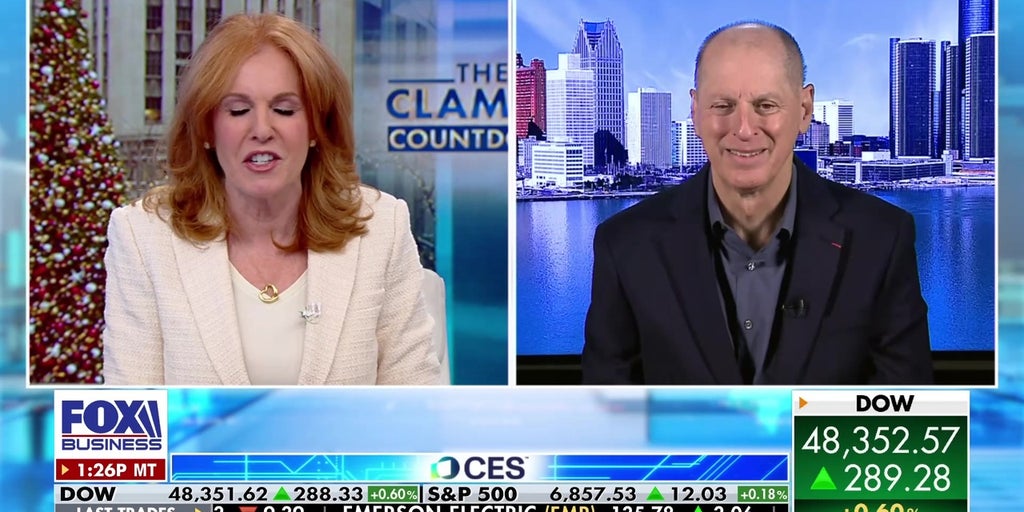
The provided text contains only a television programming schedule (Fox Business Channel and Fox News Channel line-up) and lacks any substantive financial news, company data, economic indicators, or policy information. There are no revenues, earnings, rates, or other market-relevant facts to act on, so no market-moving conclusions or investment signals can be drawn.
Market structure: The visible primetime lineup (Fox Business/News blocks) signals stability in linear TV inventory that benefits ad-supported broadcasters (e.g., FOXA/FOX) and local TV groups ahead of the 2026 political ad cycle. Limited premium inventory combined with predictable viewer blocks tends to support CPMs; expect a 10–25% bump in political-ad-heavy quarters (H2 2026) versus baseline, transferring pricing power to legacy broadcasters over pure subscription streamers.
Risk assessment: Tail risks include a sudden 10%+ acceleration in cord‑cutting or an FCC/regulatory clamp on political ad targeting that could cut revenues by >15% for some broadcasters. Time horizons: monitor daily/weekly Nielsen ratings (immediate), May–June upfronts (short-term), and election-ad spend seasonality (long-term through H2 2026). Hidden dependencies: local affiliate ad sales and agency repricing can amplify swings; a concentrated political-ad book (20–40% of H2 revenue) raises earnings volatility.
Trade implications: Tactical trades favor overweighting ad-supported broadcasters and cable infrastructure while underweighting ad-lite streamers. Directs: establish modest long positions in FOXA (2–3% NAV) into upfronts and hedge with short exposure to NFLX (1–1.5% NAV) or DIS streaming segment for 3–9 months. Options: use 4–9 month call-spreads on FOXA (buy ATM, sell +15% OTM) sized 0.5–1% notional to capture upside from CPM re-rating.
Contrarian angles: Consensus underprices political-ad concentration risk but also underestimates linear-TV’s resilience during election cycles—if weekly Nielsen shows +5–10% primetime gains, FOXA could re-rate 15–25% quickly. Beware overpaying into upfronts; set a 15% stop-loss and cap total media exposure to 6–8% NAV to avoid asymmetric election volatility and regulatory shocks.
AI-powered research, real-time alerts, and portfolio analytics for institutional investors.
Request DemoOverall Sentiment
neutral
Sentiment Score
0.00
