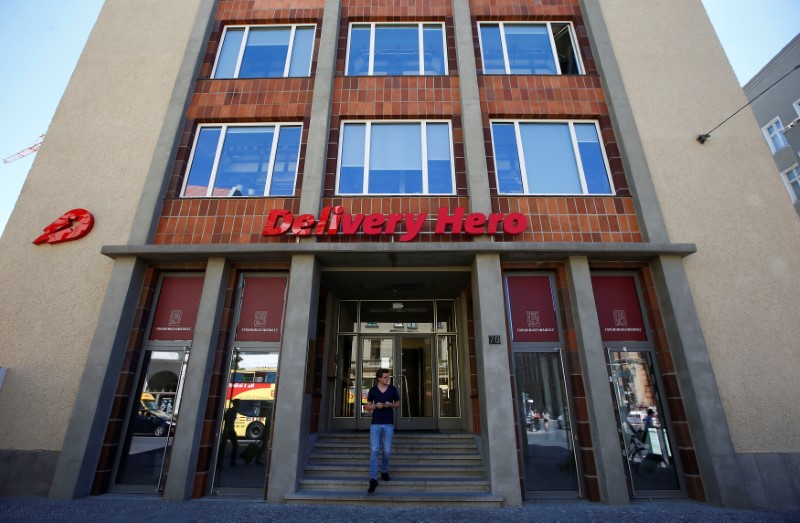
Delivery Hero's Q1 gross merchandise value rose 8.8% year-on-year to €12.5 billion, ahead of the €12.3 billion consensus, while total segment revenue increased 17.8% to €3.7 billion. Quick Commerce remained a key growth engine, with GMV up 30% and now 18% of group GMV. The company reaffirmed full-year guidance and said it expects adjusted EBITDA in the upper half of its €910 million to €960 million range.
The market is treating this as a simple delivery-app beat, but the more important signal is that a multi-sided marketplace can still widen take-rate durability while re-accelerating a lower-margin fulfillment layer. That matters because quick-commerce growth often gets dismissed as value-destructive; here, the mix shift implies the company is using denser order routing and basket expansion to improve utilization, which can translate into operating leverage faster than top-line growth alone suggests. The second-order read-through is negative for smaller, local incumbents and adjacent grocery-logistics players that rely on weak network density. If quick commerce is now a meaningful share of GMV, the competitive moat is less about brand and more about last-mile economics, warehouse proximity, and merchant depth — an arms race that tends to compress weaker players’ unit economics over the next 2-4 quarters. That can also pressure third-party courier partners and cloud-kitchen ecosystems if traffic consolidates into the dominant app. The main risk is that this is still a guidance-confirmation story, not a fresh inflection, so the stock can fade if the market decides the strategic review is the real catalyst and delays rerating until the outcome is explicit. Execution needs to hold for at least two more quarters; any deceleration in quick-commerce growth or margin slippage from promotional intensity would quickly unwind the current optimism. In a consumer-demand tape, investors may also be underpricing how much of the upside comes from basket size rather than order count, which is more fragile in a softer macro. Contrarian view: consensus may be too focused on the strategic-review optionality and not enough on the underlying quality of growth. If the business continues compounding in quick commerce while holding EBITDA at the upper end of guidance, the rerating should come from fundamentals, not M&A speculation — meaning the upside could be slower but more durable than event-driven traders expect.
AI-powered research, real-time alerts, and portfolio analytics for institutional investors.
Overall Sentiment
moderately positive
Sentiment Score
0.45
Ticker Sentiment
