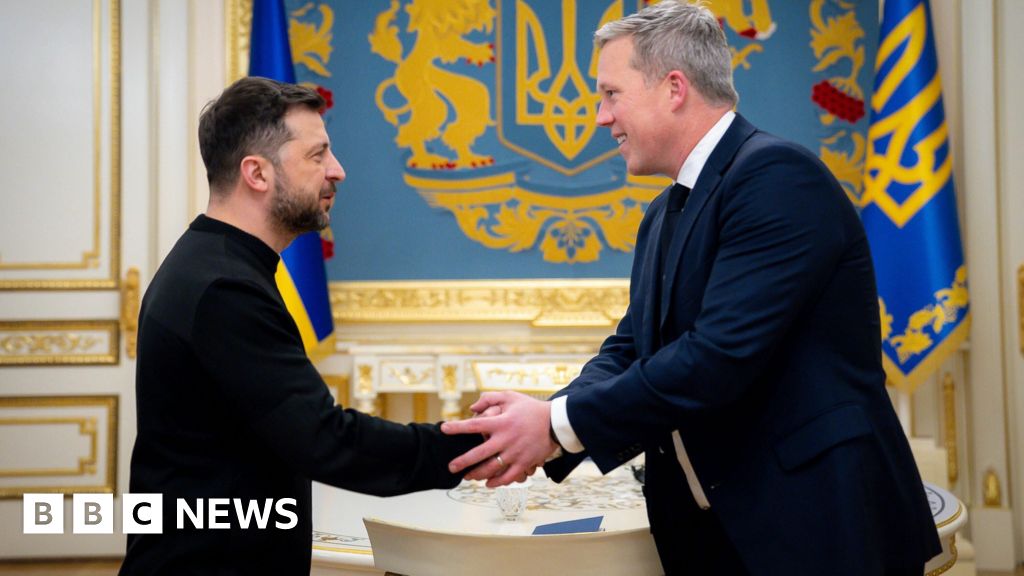
Dan Driscoll, the 39-year-old U.S. Army secretary dubbed Trump's 'drone guy,' was dispatched to lead high-profile diplomatic engagements after a leaked US-Russia 28-point peace plan, making unannounced visits to Kyiv (meeting President Zelensky), participating in Geneva talks and holding discussions with Russian officials in Abu Dhabi. A close ally of Vice-President JD Vance with a background in the Army, law and finance, Driscoll advocates mass-produced drones and AI integration in the force; his prominent role in negotiations and potential future elevation signals a shift in U.S. defense leadership and policy priorities with implications for geopolitical risk and defense-sector strategy.
Market structure: Driscoll’s profile accelerates a tactical US tilt toward low-cost, AI-enabled unmanned systems — favoring defense primes with avionics/ISR and semiconductor/edge-AI suppliers. Expect incremental reallocation of procurement budgets over 12–36 months toward firms that supply autonomy stacks, sensors and GPUs; winners: LMT, GD, RTX, NXPI, NVDA; losers: legacy manpower-heavy contractors and certain consumer discretionary names exposed to higher risk-premium. In commodities/FX expect modest upward pressure on oil and safe-haven FX if talks stall (oil +2–6% and USD up 0.5–1% on renewed contagion risk within weeks).
Risk assessment: Tail risks include a diplomatic breakdown triggering renewed kinetic escalation (low probability, high impact) that could spike oil >15% in 30 days and push 10y UST yields down 25–40bps on flight-to-safety. Hidden dependencies: semiconductor supply (TSMC capacity), export controls and congressional approval for additional aid – any of which can blunt near-term defense capex. Catalysts: US budget votes, NATO statements, and a Putin response within 2–8 weeks could materially move equities and FX.
Trade implications: Near-term (0–3 months) favor tactical long positions in LMT and NVDA (AI + defense exposure) sized 2–3% each with 12-month targets +15–30% and stop-loss at -8%. Consider buying 6–12 month call spreads on NVDA (e.g., Jul 2026 600/800) to capture secular drone-AI demand while limiting premium. Short selective gunmakers (SWHC, RGR) on potential stricter ATF enforcement; size 1–2% with tight stops.
Contrarian angles: The market may underprice sustained semiconductor/AI upside from defense demand — this is not a one-off peace-brokerage story but a policy signal toward silicon-first warfare over years. Conversely, defense primes are pricing in perpetual tail-risk; if talks advance meaningfully, short-duration defense contractors without AI payload exposure will underperform. Watch procurement RFPs, DoD budget language and NVDA GPU order flow over next 90 days for confirmation.
AI-powered research, real-time alerts, and portfolio analytics for institutional investors.
Request DemoOverall Sentiment
neutral
Sentiment Score
0.00
Ticker Sentiment
