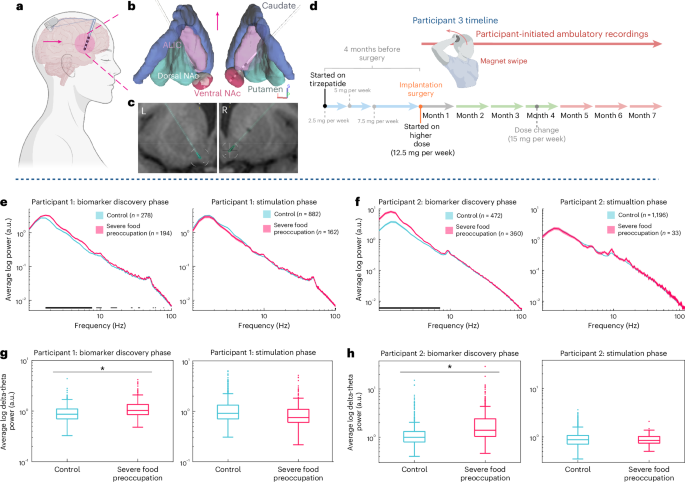
Researchers report a first‑in‑human, implant-based electrophysiology case linking tirzepatide exposure to modulation of a low‑frequency (delta–theta, ≤7 Hz) oscillatory biomarker in the nucleus accumbens that tracked episodes of severe food preoccupation: a patient on escalating tirzepatide doses showed a months‑long suppression of both the biomarker and food‑preoccupation events, followed by re‑emergence of the delta–theta signal and clinical breakthrough despite continued maximal dosing. The finding suggests incretin dual agonists can engage mesolimbic reward circuitry and that a measurable neurophysiological signal might serve as a target‑engagement biomarker to guide or combine pharmacologic and neuromodulation approaches for dysregulated eating. However, this is a single, uncontrolled case with potential confounders (surgery effects, timing, inability to withhold drug), so broader validation is required before any clinical or commercial extrapolation to new indications or biomarker‑driven development strategies.
This first-in-human intracranial electrophysiology case links tirzepatide exposure to modulation of a low-frequency delta–theta (≤7 Hz) oscillatory biomarker in the nucleus accumbens (NAc). In participants 1 and 2 the delta–theta power ramped up during severe food preoccupation with highly significant differences versus control (example P = 2.1035 × 10⁻⁶ and 2.48443 × 10⁻¹¹ for participant 1 and 2 in the left hemisphere), and responsive stimulation later reduced both the biomarker and episode counts.
In participant 3 an increase in tirzepatide dose temporally coincided with months 2–4 of quiescence in severe food preoccupation and an absence of the delta–theta biomarker (left P = 0.8105; right P = 0.1011), followed by re-emergence of the biomarker in months 5–7 despite maximal dosing when delta–theta power again became highly significant (left P = 1.5310 × 10⁻²²; right P = 1.0887 × 10⁻⁶) and episodes rose to seven per month; a supplementary cross-correlation suggested a ~7-week lag between biomarker change and behavioral breakthrough.
The data support a plausible mechanistic engagement of mesolimbic reward circuitry by tirzepatide and nominate the NAc delta–theta signal as a candidate target-engagement biomarker to guide combined pharmacologic and neuromodulation strategies. Critical caveats are that this is a single uncontrolled case embedded in an ongoing feasibility trial (NCT03868670), confounding factors (postoperative effects, inability to withdraw drug) cannot be excluded, and invasiveness limits near-term scalability; replication in controlled cohorts and development of noninvasive surrogates are required before clinical or commercial conclusions.
AI-powered research, real-time alerts, and portfolio analytics for institutional investors.
Request DemoOverall Sentiment
mixed
Sentiment Score
0.05
Ticker Sentiment
