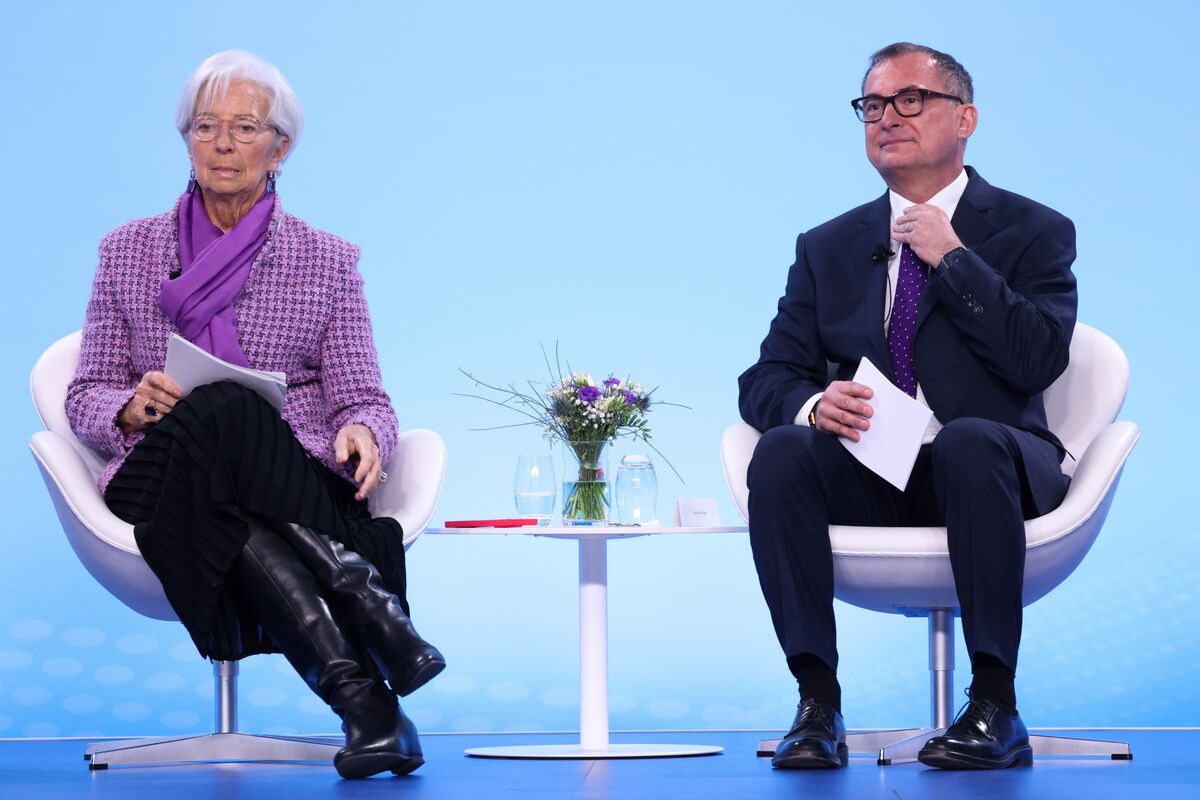
Senior European central bankers including ECB President Christine Lagarde and Bundesbank chief Joachim Nagel are publicly expanding their remit beyond price stability to address issues such as defense policy and reforms to EU decision-making. Their interventions signal a growing overlap between monetary authorities and geopolitical/governance debates, raising policy and political risks for Europe even if immediate market-moving implications for rates or inflation are limited.
Market structure: ECB officials pushing into defense/fiscal debate favors European defense primes (Airbus AIR.PA, Leonardo LDO.MI, BAE Systems BAE.L, Thales HO.PA), heavy-equipment suppliers and cybersecurity firms as direct beneficiaries of multi-year capex; consumer discretionary and luxury travel are relative losers as public budgets and political risk premiums reallocate funding. Greater fiscal activism implies upward pressure on long-term Eurozone yields and industrial commodity demand (copper/aluminum), shifting pricing power toward suppliers of specialized defense inputs over OEMs in a 6–24 month window.
Risk assessment: Tail risks include politicization of ECB credibility triggering >100bp spike in Eurozone inflation expectations or a sovereign stress episode widening peripheral spreads by 200–400bp; immediate risk (days-weeks) is headline-driven volatility, while meaningful fiscal/procurement outcomes take 3–18 months. Hidden dependencies: defense procurement lead times, EU rule changes, and national elections; catalysts are EU summits, NATO statements, and ECB minutes.
Trade implications: Tactical trades include long select defense equities and currencies (EUR vs CHF) and a 6–18 month steepener in German curve (long 10y vs short 2y) to capture fiscal-driven term premium; use covered call or call-spread structures to limit downside while capturing upside from policy announcements within 3–9 months. Rotate overweight to Industrials/Defence and Cybersecurity, underweight Consumer Discretionary/Travel, and hedge tail-risk with peripheral sovereign protection.
Contrarian angles: Consensus fears central-bank politicization leading to euro weakness and stop-go policy; overlooked is that coordinated EU fiscal commitments can raise European CAPEX and EUR carry, so weakness may be short-lived and underprices industrial earnings upside. The market may be overpricing sovereign safety (Bunds) and under-appreciating defense-capex multipliers—mispricings ripe for a 6–12 month mean reversion trade if EU policy statements translate into budgets.
AI-powered research, real-time alerts, and portfolio analytics for institutional investors.
Request DemoOverall Sentiment
neutral
Sentiment Score
0.00
