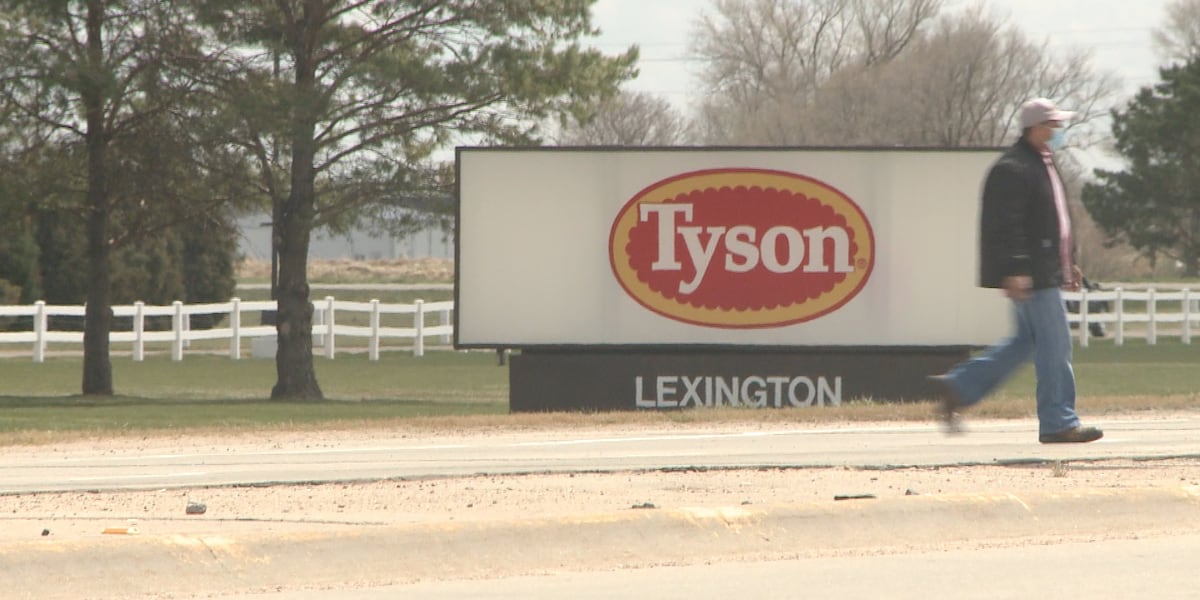
Tyson Foods will permanently cease operations at its Lexington, Nebraska beef-processing plant — which employs 3,212 workers — with job operations ending on or about January 20, while converting its Amarillo, Texas beef facility to a single full-capacity shift as part of a company reorganization. The move has drawn bipartisan political criticism and industry concern over regional processing capacity and cattle market impacts, while local employers (including Sustainable Beef) expect to hire some displaced workers; the action poses near-term regional economic risk and may modestly affect beef-processing capacity and Tyson’s operational footprint in Nebraska.
Market structure: The reallocation of regional slaughter capacity tightens local supply chains and increases short-run pricing power for surviving processors and packer-integrators; expect localized wholesale beef spreads to widen by roughly $5–10/cwt over 1–3 months and live-cattle futures to react +2–5% if utilization drops. Public winners are nimble, lower-cost processors and branded food companies able to secure throughput (e.g., PPC, HRL); losers are large, inflexible processors with heavy fixed costs and political/regulatory exposure (e.g., TSN). Cross-asset: a modest rise in grocery inflation risk could lift short-term Treasury breakevens by ~5–10bp, tighten high-yield spreads for food retailers, and raise volatility in TSN equity/options and CME live-cattle contracts.
Risk assessment: Tail risks include regulatory intervention (anti-trust or mandatory reopen orders), major labor disputes spreading across plants, or rapid herd liquidation that reverses price spikes; each could move cattle futures ±10% in 3–6 months. Immediate (days) risk is headline-driven volatility in TSN; short-term (weeks/months) is margin reallocation among packers; long-term (quarters/years) is structural capacity rationalization and potential consolidation. Hidden dependencies: regional trucking, USDA inspection throughput, and feed/corn prices can amplify effects; political pressure could produce subsidies or contract backfills.
Trade implications: Favor relative-value plays: go long smaller, efficient processors and branded packaged-meat (PPC, HRL) while hedging TSN downside via put spreads. Express commodity exposure via a 3-month long live-cattle futures/Call-spread sized ~1% AUM to capture interim tightness, hedge corn correlation if corn >$7/bu moves. Time entries into 0–6 weeks; exit or reweight if weekly federally inspected slaughter normalizes within ±1% for three consecutive weeks or if live-cattle falls/rises >6%.
Contrarian angles: Consensus prices persistent scarcity; history shows closures often produce only transitory wholesale spikes as throughput rebalances across plants and imports fill gaps within 2–6 months. The market may be overstating long-term capacity loss — consider mean-reversion in TSN equity if management communicates capex redeployment or divestiture that preserves margins. Unintended consequences: political backlash could accelerate M&A or targeted support for mid-size processors, creating consolidation winners absent today’s pricing.
AI-powered research, real-time alerts, and portfolio analytics for institutional investors.
Request DemoOverall Sentiment
strongly negative
Sentiment Score
-0.60
