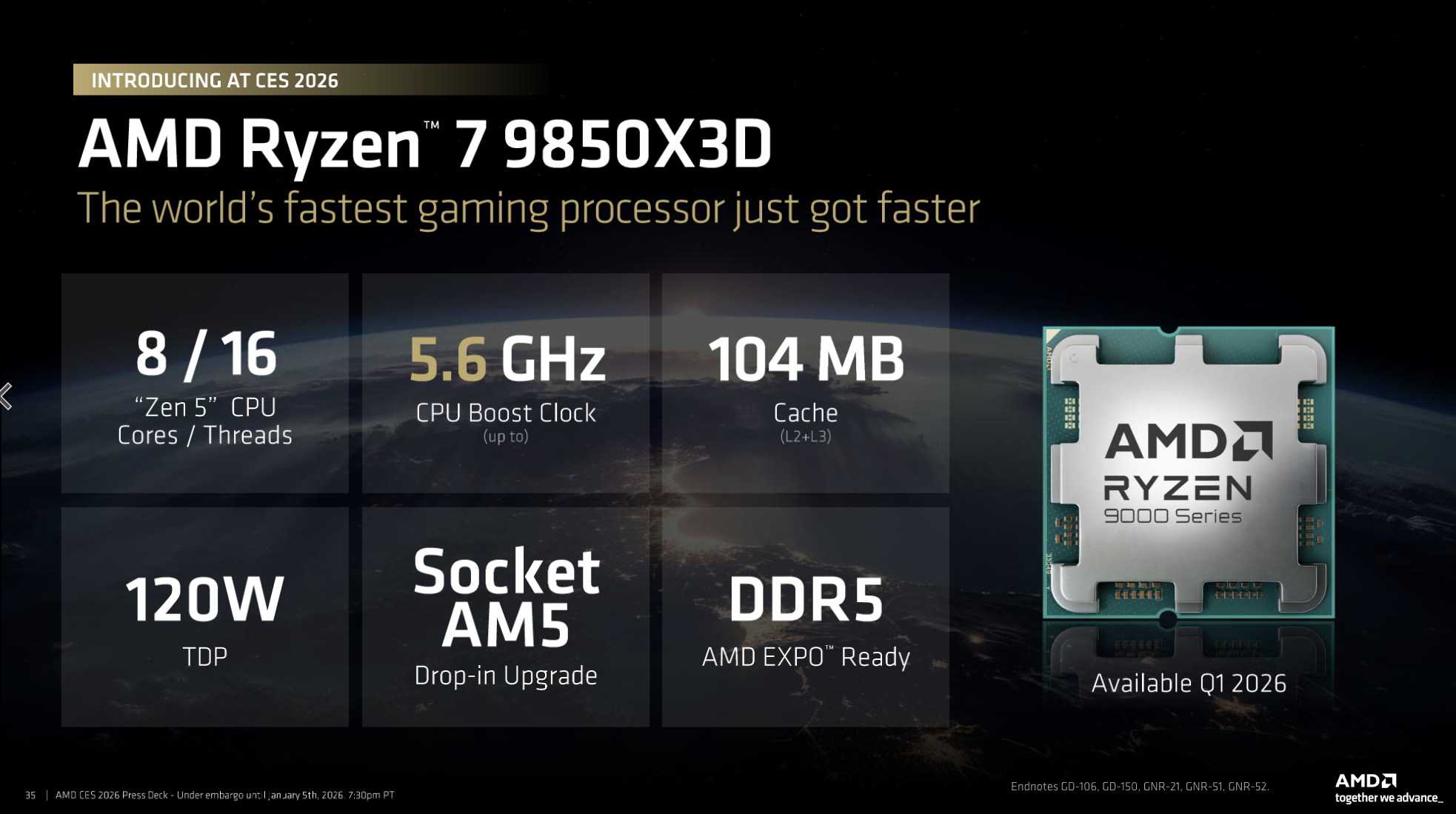
AMD has announced the Ryzen 7 9850X3D, a refined 8-core/16-thread Zen 5 X3D CPU with a 400 MHz higher boost (up to 5.6 GHz), the same 120W TDP and 104 MB total cache; AMD claims an average 7% gaming uplift over the Ryzen 7 9800X3D but shows only marginal gains in many titles with larger benefits limited to frequency-sensitive esports games. The company plans to sell the new part alongside the 9800X3D in Q1 2026 (OEM systems appearing in February), and has not disclosed MSRP—pricing will determine whether it pressures 9800X3D street prices and meaningfully shifts competitive positioning versus Intel’s Core Ultra 9 285K. For investors, the launch is an incremental product refresh that tightens AMD’s gaming lineup but is unlikely to drive large near-term revenue or margin changes absent notable pricing or share gains.
Market structure: The Ryzen 7 9850X3D is a marginal performance lift (AMD's own data ~7% gaming uplift) that benefits AMD (AMD) and OEMs who can market a “new fastest” SKU, while risking near-term cannibalization of the Ryzen 7 9800X3D and compressing ASPs if priced at parity. Intel (INTC) loses some competitive talking points in gaming, and TSMC (TSM) is a neutral-to-positive beneficiary from higher-bin demand; impact to rates/FX is negligible but equity implied vol on AMD/INTC will spike around MSRP and reviews.
Risks: Tail risks include aggressive internal price cuts (leading to >200–300bp gross margin erosion over two quarters), disappointing independent benchmarks, or yield/TSMC supply hiccups delaying shipments into 1H26. Timeline: immediate (days) — sentiment moves on MSRP/news and Alienware Feb preview; short-term (0–3 months) — retail pricing and channel inventory; long-term (2–8 quarters) — product-stack cannibalization and margin mix. Monitor MSRP and retail listings within 0–30 days; if MSRP >$499 expect ASP lift, if ≤$450 expect margin pressure.
Trades: Favor a directional overweight in AMD into Q1 2026 product cycle (2–3% position) and a relative short on INTC to express gaming competitiveness; add a modest long in TSM (1–2%) for foundry mix if March capacity comments are supportive. Use options to cap downside: buy a 3–5 month AMD call spread ahead of MSRP to capture upside while limiting premium; consider a put hedge if AMD/9800X3D price falls >8% post-launch.
Contrarian: Consensus may underprice cannibalization — a low-price 9850X3D would be negative for AMD margins but positive for share and TSM volumes; conversely, the market may under-appreciate OEM adoption (Alienware Feb) that could lift unit sales ~5–10% in Q1 2026. Historical parallels: incremental frequency-bumped SKUs often force channel markdowns within one quarter. Unintended consequence: inventory write-downs at retailers could create a buying opportunity if AMD’s gross margin guidance remains intact.
AI-powered research, real-time alerts, and portfolio analytics for institutional investors.
Request DemoOverall Sentiment
mixed
Sentiment Score
0.08
Ticker Sentiment
