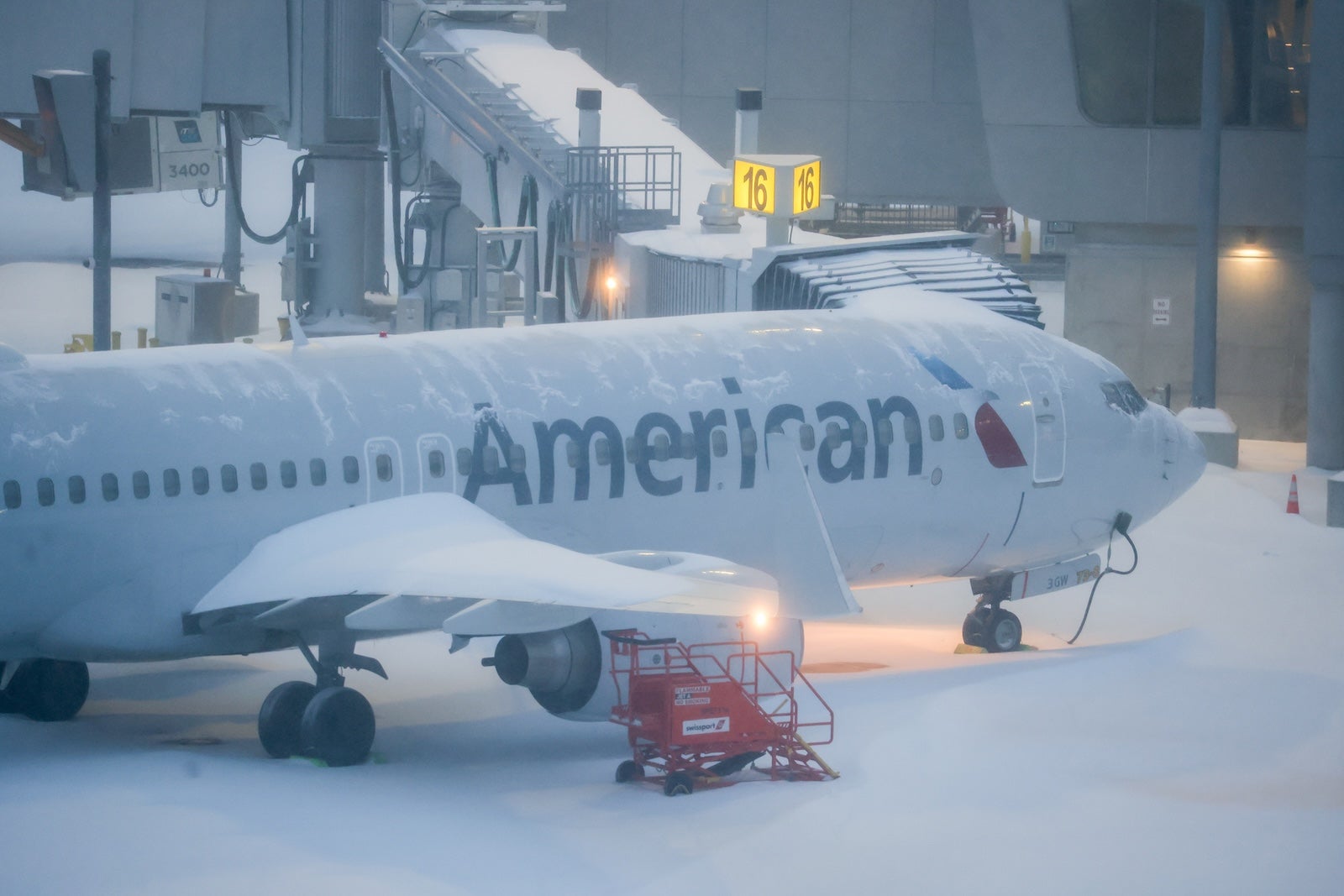
American Airlines suffered its largest operational disruption ever after Winter Storm Fern shuttered more than 20,000 flights between Saturday and Monday, leaving about 1,800 cancellations by midday Tuesday. By 12:45 p.m. EST Tuesday the carrier had canceled an additional 879 mainline flights (roughly 30% of that day's schedule) and significant regional flights as five of its nine hubs — including DFW, CLT, DCA, PHL, LGA/JFK — were hit hard; CEO Robert Isom warned of at least two more days of elevated cancellations and extended travel advisories through Thursday, raising near-term revenue and cost pressures and creating a notable short-term operational risk for the stock.
Market structure: American (AAL) is the clear near-term loser — 20,000+ cancellations and continuing 30% of daily mainline schedule risk a near-term revenue hit and higher re-accommodation costs; Delta (DAL) and smaller network or low-cost carriers (LUV, JBLU) are likely beneficiaries as customers rebook. The network-concentrated nature of AAL’s hubs (DFW, CLT, LGA, JFK, PHL) amplifies market-share volatility regionally: expect 1–3ppt short-term share loss on affected routes and transient fare spikes on remaining capacity, supporting incumbents with intact hubs.
Risk assessment: Immediate (0–7 days) operational risk dominates — CEO expects two more days of elevated cancellations — translating to measurable Q1 revenue and OTP deterioration. Short-term (weeks–months) risks include reputational churn and higher opex (overtime, repositioning) and potential DOT scrutiny/class action if mishandled; long-term (quarters) tail risks include revised crew/rest rules or capital allocation shifts raising unit costs by mid-single digits. Hidden dependencies: crew/aircraft positioning and maintenance backlogs can create multi-week cascades; a second storm within 30 days is a non-trivial 10–20% conditional risk to full recovery.
Trade implications: Tactical short AAL equity (size 2–4% portfolio) with a paired long in DAL (1–2%) to capture relative reliability; execute a short-dated (30–60 day) AAL 5–10% OTM put spread (0.5–1% portfolio) to monetize elevated IV while capping capital. If credit spreads on AAL widen >75–100bps vs. peers, buy AAL senior bonds or CDS protection size 0.5–1% to harvest yield/hedge equity exposure; consider buying DAL 3-month calls (or 1–2% outright) if market reprices AAL disproportionately.
Contrarian angles: Consensus may overstate permanent damage — historical winter-storm shocks typically mean-revert within 3–6 months; if AAL equity falls >15% on this event alone, consider buying long-dated (9–12 month) call spreads sized 0.5–1% as a recovery play. Watch for unintended consequences: operational audits or capex increases could meaningfully compress margins — if management signals >$100–200m incremental remediation spend on the next call, re-short AAL and rotate into reliably managed carriers.
AI-powered research, real-time alerts, and portfolio analytics for institutional investors.
Request DemoOverall Sentiment
moderately negative
Sentiment Score
-0.60
Ticker Sentiment
