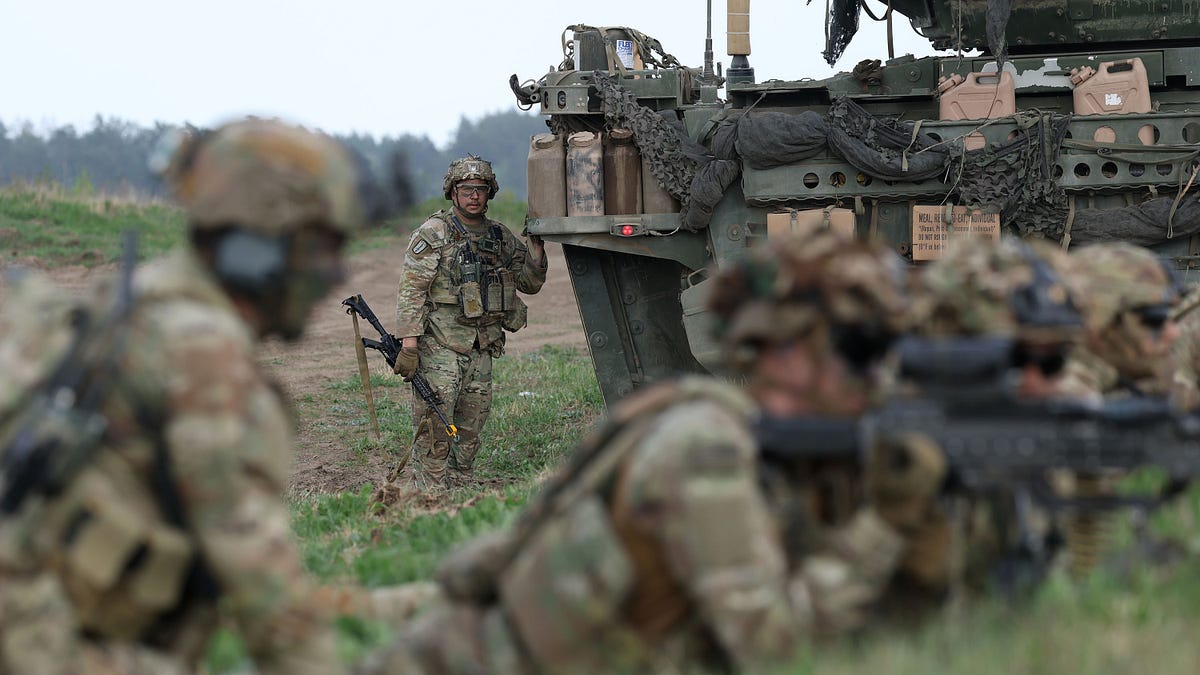
The Trump administration abruptly halted a planned deployment of roughly 4,000 U.S. troops to Poland and announced the withdrawal of another 5,000 troops from Europe, surprising Pentagon officials and rattling allies. The article argues this weakens NATO deterrence, disrupts training and interoperability, and signals strategic confusion at a time when Russia benefits from allied uncertainty. The move could have broad geopolitical implications and increase risk around U.S.-Europe defense coordination.
The market implication is not direct defense-budget arithmetic; it is a deterioration in alliance reliability premium. That tends to surface first in European defense primes and infrastructure names with NATO exposure, because procurement urgency rises when forward-deployed U.S. capacity becomes less predictable. The second-order winner is less obvious: domestic European rearmament and stockpiling cycles become more self-funded and less U.S.-dependent, which should support medium-duration order books for artillery, air defense, ammunition, logistics, and military mobility over the next 12-36 months.
The bigger risk is not troop count but deterrence mispricing. If allies begin to assume U.S. commitments can be repriced quickly for domestic political reasons, you get a faster shift toward redundant capabilities, pre-positioning, and sovereign command-and-control spend. That is bullish for European integrators and selected U.S. contractors with exportable systems, but bearish for any firm reliant on a stable, centrally coordinated NATO procurement framework. A sloppy signaling regime also raises the odds of a temporary escalation premium in European credit and FX, especially in Poland and the Baltics, if investors start assigning a higher tail probability to a security shock.
The contrarian view is that the move may be overread as a permanent strategic retreat. If this is mainly bargaining leverage, the eventual outcome could be a reordered posture rather than a net reduction, which would mean the immediate market reaction in European defense could fade after 1-3 weeks. Still, the process damage is real: once allies accelerate contingency planning, the incremental demand for air defense, munitions, satellite comms, and battlefield logistics rarely gets walked back quickly. In other words, the trade is less about U.S. force levels and more about the premium on autonomous European capacity.
AI-powered research, real-time alerts, and portfolio analytics for institutional investors.
Request DemoOverall Sentiment
moderately negative
Sentiment Score
-0.45
For U.S. defense contractors, the near-term beneficiary is less the prime customer than the export pipeline; allies that doubt permanence will buy faster and in smaller batches. That favors systems with short delivery cycles and high interoperability, while penalizing bespoke programs that depend on multiyear joint planning. The cleanest expression is to own the companies that monetize urgency, not the ones that monetize stability.
