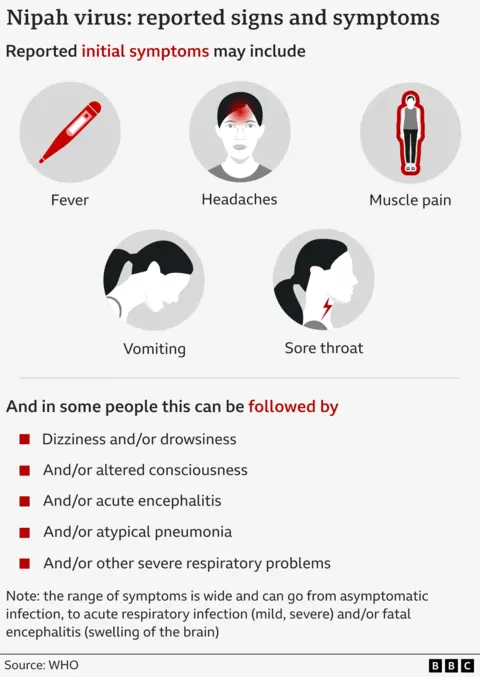
Two confirmed Nipah virus cases in West Bengal, reportedly in healthcare workers since December, have triggered regional precautions — Thailand and Nepal have begun passenger screenings at airports and border points and Taiwan has proposed listing Nipah as a Category 5 disease. About 196 contacts have been traced and tested negative; with no approved vaccines or treatments and an estimated case-fatality rate of 40–75%, the outbreak poses epidemiological risk that could transiently hit regional travel and tourism activity, though current evidence points to limited immediate economic impact.
Market-structure: Immediate winners are diagnostics, testing and PPE suppliers (Abbott ABT, Thermo Fisher TMO, QuidelOrtho QDEL, PerkinElmer PKI) as airports and health ministries scale screening; travel/leisure (airlines, cruises, regional hotels) are near-term losers given route-based screening and potential demand drag. Expect a 1–5% demand shock to regional air travel flows in South Asia over 2–8 weeks if containment holds; a sustained outbreak with cross-border cases could push 10–25% downside in vulnerable carrier revenues over a quarter.
Risk assessment: Tail risk is a low-probability (<5%) but high-impact sustained human-to-human transmission beyond India that triggers broader travel restrictions and supply-chain disruption; immediate risk (0–14 days) is limited to screening delays and localized ticket rebooking, short-term risk (1–3 months) depends on WHO classification and case trajectory. Hidden dependencies include insurance claims, corporate travel cutbacks, and regional FX weakness (INR) from tourism receipts; catalysts that would accelerate dislocation are WHO escalation, confirmed export cases, or mortality clusters in urban centers.
Trade implications: Favor tactical longs in diagnostics/clinical labs (size 1–3% each) and tactical shorts/hedges in travel (U.S. Global Jets ETF JETS, specific carriers AAL, UAL) via 1–3 month options to capture volatility; cross-asset expect small safe-haven bid to government bonds (yields down 5–15bps) and modest gold upside (+1–3%) if escalation occurs.
Contrarian angles: Consensus fear may oversell travel names by >15% intraday on headlines; if cases remain contained (no WHO PHEIC within 30 days) travel sector should recover quickly—presenting mean-reversion buy opportunities. Conversely, diagnostics names already rich after Covid should be chosen by margin of recurring revenue and balance-sheet strength (TMO, ABT) to avoid overpaying for one-off spikes.
AI-powered research, real-time alerts, and portfolio analytics for institutional investors.
Request DemoOverall Sentiment
mildly negative
Sentiment Score
-0.30
