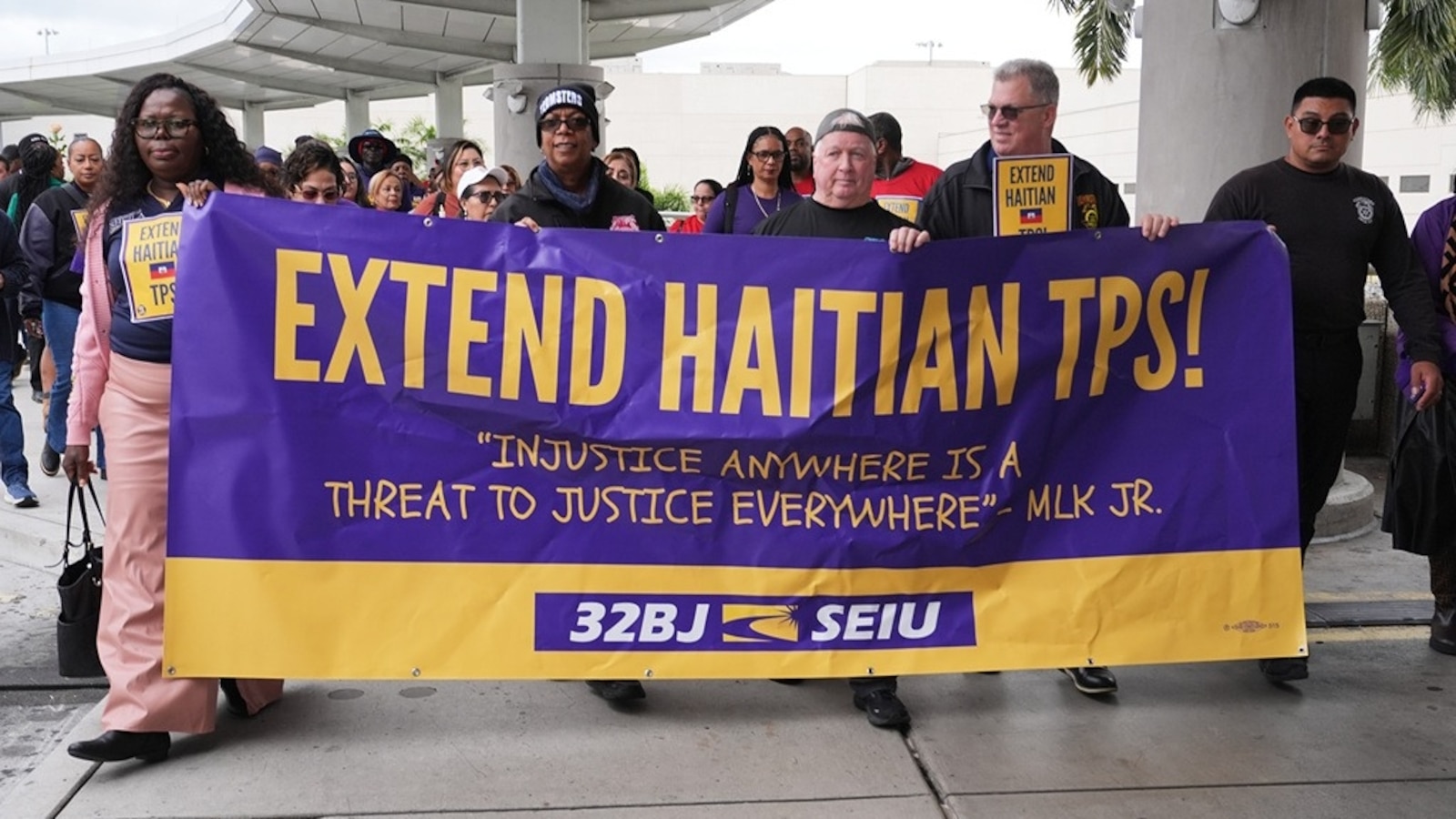
A federal judge (Ana Reyes) issued an 83-page opinion granting a stay that blocks the administration from terminating Temporary Protected Status for roughly 352,959 Haitian nationals, preserving their work authorization and deportation protections pending judicial review. Judge Reyes criticized DHS Secretary Kristi Noem for preordaining the termination decision and cited failure to apply the facts and law; five named plaintiffs include scientists, engineers, a nurse and a college student. DHS signaled it will appeal toward the Supreme Court, creating legal and policy uncertainty but presenting minimal direct near-term market impact outside potential localized labor and sector-specific implications.
Market structure: The injunction preserves legal status for ~352,959 Haitian TPS holders — a concentrated, low-wage-to-skilled-labor cohort (nurses, bank IT, hospitality) whose continued work authorization reduces immediate labor disruption in regional labor markets (Florida/NY/NJ) and sustains remittance flows. Winners: remittance processors (WU/MQ), healthcare staffing (AMN) and regional hospitality operators (MAR/HLT) that rely on immigrant labor; losers: private detention/immigration-enforcement contractors and politically exposed short-term trade opportunities tied to an abrupt workforce cutoff.
Risk assessment: Tail risk centers on an adverse appellate outcome (DHS appeal to D.C. Circuit or SCOTUS) within 30–180 days that could reverse protections and cause localized labor shortages, wage spikes, or credit stress for small businesses and community banks. Hidden dependencies include municipal budgets (school/hospital payroll), state-level labor supply elasticity, and concentrated employer exposure; monitor case docket and appellate briefing cadence as 0–3 month catalysts.
Trade implications: Favor idiosyncratic, regionally exposed long positions sized 1–3% of NAV: remittance processors and staffing providers for 3–12 month holds; use 3–6 month call spreads to limit downside and capture event-driven re-rating if injunction holds. Hedge with short-duration muni exposure or 0.5–1% long protection (put spreads) on vulnerable regional banks if litigation turns adverse.
contrarian angles: The market treats this as purely political noise, understating the microeconomic benefits of avoiding a sudden 350k shock to low/medium-skilled labor in concentrated metros — this is a liquidity/save-the-job flow rather than a macro immigration shift. Overdone reactions would be broad short positions in hospitality or staffing; underdone opportunity is long small-cap community banks with diversified loan books in Haitian-heavy metros if injunction persists (6–12 months). Historical parallel: prior TPS cycles produced multi-year status quo extensions, not immediate mass departures.
AI-powered research, real-time alerts, and portfolio analytics for institutional investors.
Request DemoOverall Sentiment
neutral
Sentiment Score
0.00
