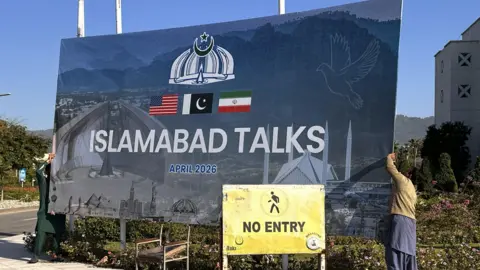
Iran-US talks in Islamabad ended without an agreement after 21 hours, leaving the contested ceasefire and negotiations over Iran's nuclear program unresolved. The Strait of Hormuz remains a key flashpoint, with closure already causing economic shocks worldwide and posing a major risk to oil, gas, and broader trade flows. Both sides say discussions may continue, but the lack of a breakthrough keeps escalation risk elevated and markets on edge.
The market is pricing a binary that is too coarse: this is not yet a peace outcome, but it is also not a clean failure. The more important signal is that both sides now have a live negotiating channel under military pressure, which increases the probability of repeated stop-start extensions rather than a single decisive break. That favors elevated volatility in crude, shipping insurance, and regional FX over a directional one-way move.
The first-order winner from stalemate is still the energy complex, but the second-order winner is any asset tied to logistics optionality: tanker owners, LNG shippers, and insurers with pricing power. A prolonged but non-catastrophic disruption to Hormuz can keep prompt barrels tight without immediately forcing global recession, which is the sweet spot for upstream cash flow and freight rates. The loser set broadens beyond importers: Asian refiners, European industrials, and EM current-account stories get hit through higher input costs and weaker terms of trade even if headline oil retraces.
The key catalyst is not whether talks continue, but whether either side decides the ceasefire is being used as cover for rearmament. That creates a short fuse measured in days to weeks, while the macro pass-through is a months-long process through fuel inflation, shipping bottlenecks, and central bank reaction functions. If Washington concludes negotiations are being gamed, the market should expect a violent risk-off move with energy up and cyclicals down; if the diplomatic channel survives another round, implied volatility in oil should decay faster than spot.
Consensus is likely underestimating how asymmetric the ceiling on oil is versus the floor. If the standoff persists without outright closure, the rally can grind higher via war premium and inventory hoarding even without physical shortages; if diplomacy improves, downside in crude is cushioned by residual sanction risk and infrastructure fragility. That makes options cleaner than outright directional futures here, and favors relative-value expressions over macro beta.
AI-powered research, real-time alerts, and portfolio analytics for institutional investors.
Request DemoOverall Sentiment
moderately negative
Sentiment Score
-0.35
