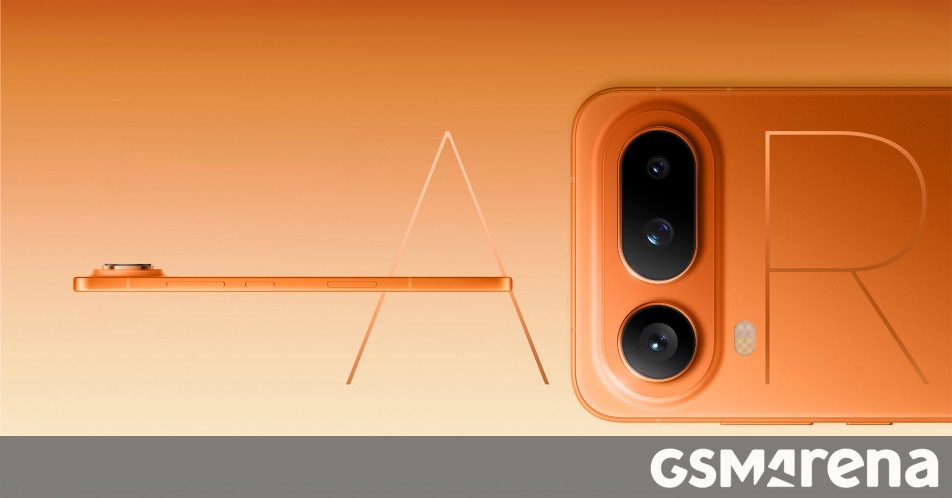
Honor launched the Magic8 Pro Air, a premium thin-and-light smartphone targeted at competing with iPhone Air and other slim Android models, featuring a 6.31-inch LTPO AMOLED 120Hz display, 6,000 nits peak local brightness, and a 50MP front camera. Key hardware includes a triple rear camera system (50MP main 1/1.3" with OIS, 64MP 3.2x periscope 1/1.2" with OIS, 50MP ultrawide), MediaTek Dimensity 9500, up to 16GB LPDDR5x RAM and 1TB UFS4.1 storage, a 5,500mAh Si-C battery with 80W wired/50W wireless charging, and an IP68/IP69 chassis at 6.1mm and 155g. Pricing starts at CNY 4,999 (~$717) for 12/256GB and CNY 5,999 (~$860) for 16/1TB, with Chinese sales opening January 23 and no global rollout detailed yet.
Market structure: Honor’s Magic8 Pro Air is a direct signal that Chinese OEMs are competing on “flagship specs at lower ASP” rather than pure premium pricing — CNY4,999 (≈$717) for a 12/256GB flagship is likely to put pricing pressure on mid‑tier models from Xiaomi (1810.HK) and constrain ASPs for the Android thin‑and‑light segment over the next 3–6 months. Component winners are SoC and foundry (MediaTek 2454.TW, TSMC 2330.TW), DRAM/NAND (SK Hynix 000660.KS, Micron MU), and high‑brightness LTPO panel suppliers (Samsung Display/BOE); losers are incumbents who can’t match cost/weight specs or scale. Expect modest downward pressure on OEM margins but incremental revenue for component vendors if sell‑through hits >300k units/month in China.
Risk assessment: Tail risks include a China export/regulatory shock, device recall (battery Si‑C tech), or MediaTek/TSMC capacity shortfalls — each could swing device availability +/-30% in a quarter. Immediate risk window is Jan 23 sales launch (days); short term is next 2–3 months as channel sell‑through and inventory reports appear; long term (3–12 months) depends on global rollout and whether Honor competes on volume vs. margin. Hidden dependencies: Honor’s trajectory depends on chip allocations, battery supplier scale (possible CATL exposure), and successful Android OS customization; any supplier bottleneck amplifies stock moves in component names.
Trade implications: Direct plays — establish tactical 2–3% long positions in MediaTek (2454.TW) and TSMC (2330.TW) to capture China SoC/foundry uplift with a 6–12 week horizon; overweight SK Hynix (000660.KS) or MU by 1–2% for increased memory content per device. Pair trade — long MediaTek (2454.TW) / short Qualcomm (QCOM) 1% each to play further domestic SoC share gains; use 3‑month call spreads on MediaTek (buy 10% OTM, sell 25% OTM) to limit capital and target a 2–3x payoff if shares reprice on strong sell‑through. Entry: init 50% size 1–2 weeks before Jan 23, add to strength up to target; stop loss 8–12%.
Contrarian angles: The market will underweight the positive revenue lift to memory and storage vendors from higher per‑device content (LPDDR5x, UFS4.1); this is likely underpriced if Honor scales globally — imply +2–5% upside to SK Hynix/Micron over 3–6 months. Conversely, the reaction could be overdone against Xiaomi (1810.HK) if user loyalty keeps its ASPs intact; historical parallels (OnePlus/realme disrupting but not displacing Apple/AAPL) suggest winners among component suppliers, not all OEMs. Unintended consequence: aggressive OEM pricing can force component suppliers into rebate/margin concessions, creating a late‑cycle inventory risk for semi names into H2 2026.
AI-powered research, real-time alerts, and portfolio analytics for institutional investors.
Request DemoOverall Sentiment
moderately positive
Sentiment Score
0.45
