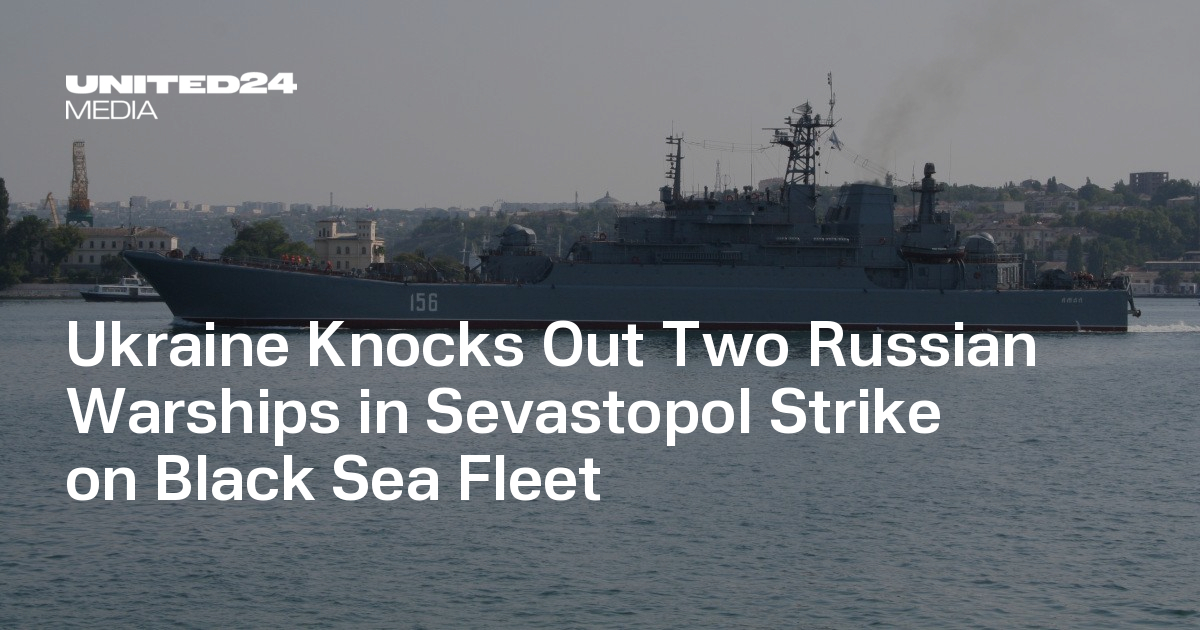
Ukraine’s HUR said it disabled two Russian Black Sea Fleet landing ships in Sevastopol Bay on April 19: the Project 775 Yamal, valued at over $80 million, and the Project 1171 Nikolai Filchenkov, valued at over $70 million. The strike also destroyed a Podlet-K1 radar system worth about $5 million, reducing Russia’s surveillance and logistics capability in temporarily occupied Crimea. The report underscores ongoing escalation in the Black Sea theater and could weigh on regional risk sentiment.
This is a marginal but compounding degradation of Russia’s Black Sea denial architecture: the immediate military effect is less about tonnage and more about forcing the fleet and its enablers to operate farther from the threat envelope, which raises transit time, fuel burn, maintenance load, and sortie risk. The destroyed radar piece matters disproportionately because sensors are the cheapest way to preserve expensive platforms; once the ISR layer is thinned, even survivable assets become less useful and more conservative in employment. The second-order market implication is that Russia’s logistics cost curve around Crimea is becoming structurally worse, not just episodically disrupted. That tends to cascade into higher demand for air-defense interceptors, dispersed storage, redundant communications, and rail/road hardening — all of which are slower, more capital-intensive substitutes. Over weeks to months, this favors Western and regional defense suppliers with electronic warfare, counter-UAS, and surveillance exposure more than traditional shipbuilders. The near-term catalyst path is asymmetric: each successful strike increases the probability of operational pullback, but a visible Russian retaliation could temporarily lift headline risk and defense-volatility. The more important reversal condition is not tactical success, but if Russia adapts by shifting assets out of Sevastopol and hardens its sensor layer; that would reduce future strike effectiveness without changing the broader attrition trend. The trade is therefore more about persistence of pressure than one-off asset destruction. Consensus may be underestimating how much of the Black Sea contest is now an infrastructure and command-and-control war rather than a platform-vs-platform war. If that framing is right, the equity beneficiaries are the firms selling sensing, jamming, and autonomous systems, while the losers are legacy heavy-platform programs with slow refresh cycles. The overdone part may be assuming every successful strike materially changes the war; the underdone part is the cumulative effect on Russia’s logistics economics and force posture over the next 3-6 months.
AI-powered research, real-time alerts, and portfolio analytics for institutional investors.
Request DemoOverall Sentiment
strongly negative
Sentiment Score
-0.75
