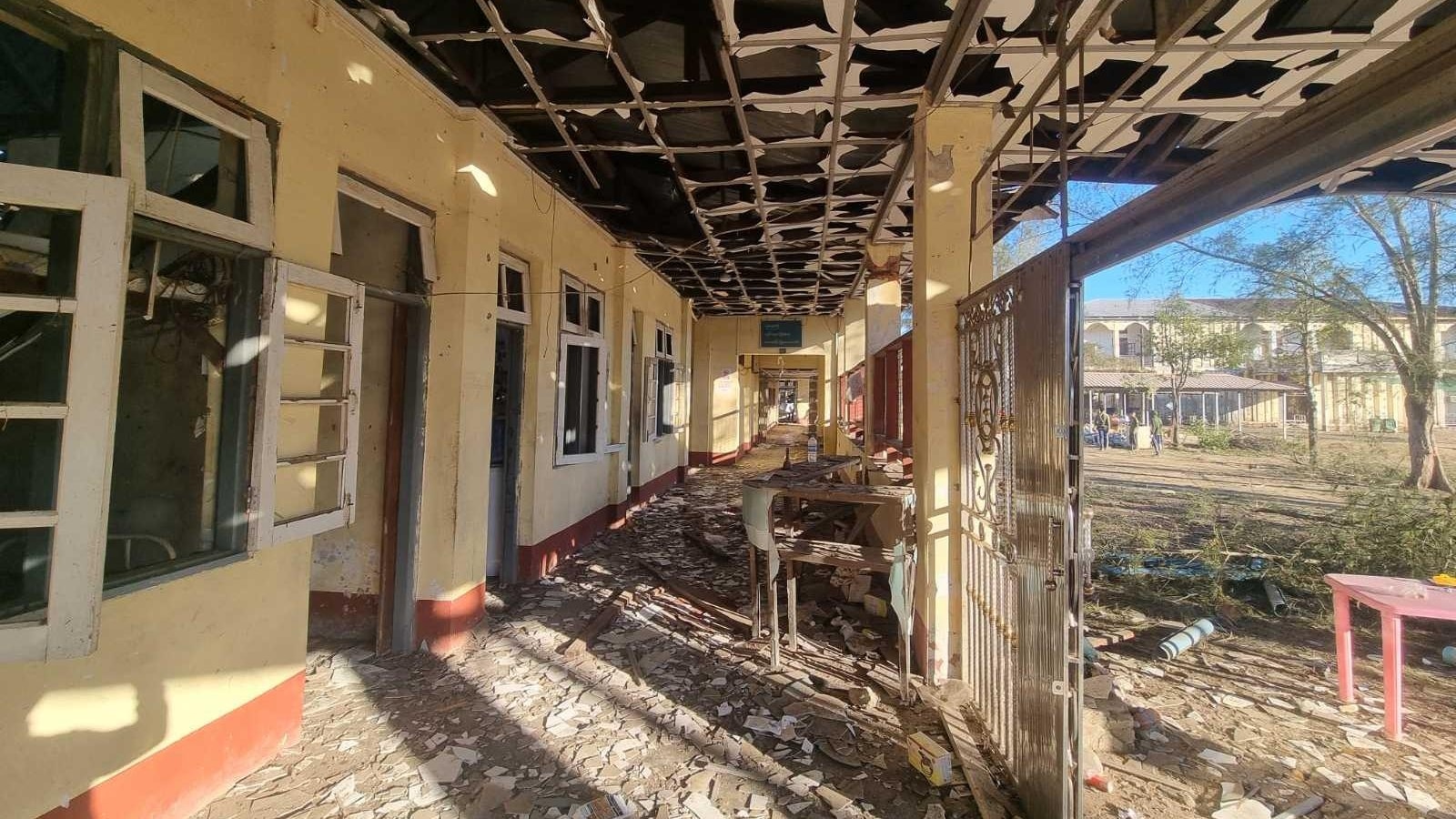
Myanmar military jets struck a general hospital in Mrauk-U township in Rakhine on Wednesday night, killing 34 patients and staff (17 women and 17 men) and injuring about 80 after two bombs hit the recovery ward and near the main building, local rescue officials and independent media said; most of the facility was destroyed. The hospital — reopened to provide scarce care after many Rakhine hospitals closed amid fighting — sits in territory seized by the Arakan Army, the well-armed ethnic Rakhine insurgent force that controls much of the state. The attack drew condemnation from the shadow National Unity Government and underscores an escalation of military airstrikes as Myanmar’s junta, in power since the 2021 coup, intensifies operations ahead of Dec. 28 elections, prompting calls for international pressure and humanitarian assistance.
A nighttime airstrike by Myanmar’s military destroyed the general hospital in Mrauk-U township, Rakhine, killing 34 patients and medical staff (17 women and 17 men) and injuring about 80 after two bombs struck at 9:13 p.m., one hitting the recovery ward and the other near the main building; most of the facility was rendered inoperable and surrounding vehicles were damaged. Local rescue officials and Rakhine-based media documented photos and videos of extensive structural and medical-equipment damage, while the junta has not publicly acknowledged the operation.
The hospital served as a primary source of care in Rakhine after many facilities closed amid ongoing civil conflict and was reopened by doctors to meet urgent needs; Mrauk-U has been under Arakan Army control since February and the insurgent force has seized a regional army headquarters and 14 of 17 townships since its November 2023 offensive. The attack prompted condemnation from Myanmar’s shadow National Unity Government, which has called for international pressure and humanitarian assistance.
The strike fits a pattern of intensified military air operations ahead of the Dec. 28 elections against armed opponents associated with the National Unity Government and People’s Defense Force, raising the prospect of further escalation and civilian displacement consistent with past operations (the 2017 Rohingya exodus is cited as context). Data signals show strongly negative sentiment (−0.8) and a low direct market-impact score (0.15), indicating high humanitarian and political significance but limited immediate global market disruption, though local operational and geopolitical risks are elevated.
AI-powered research, real-time alerts, and portfolio analytics for institutional investors.
Request DemoOverall Sentiment
strongly negative
Sentiment Score
-0.80
