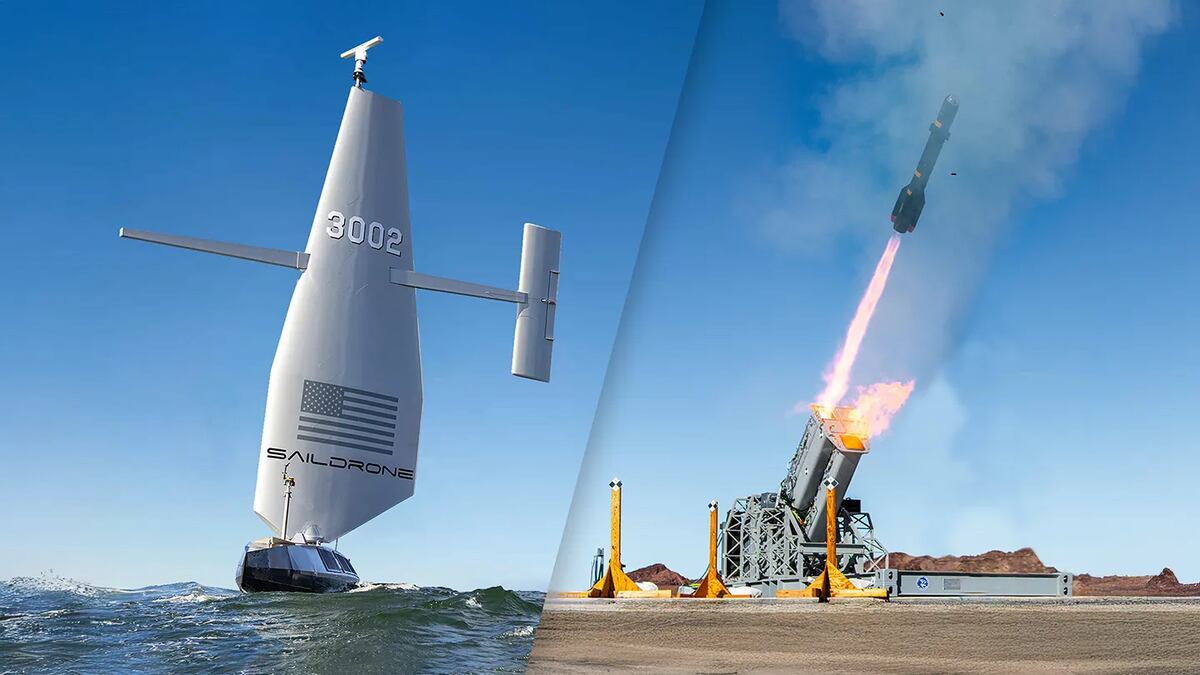
Saildrone will integrate Lockheed Martin’s Joint Air-to-Ground Missile (JAGM) launcher onto its 20-meter Surveyor unmanned surface vessel and is exploring larger USVs with containerized launchers, backed by a $50 million investment from Lockheed Martin; Saildrone plans proof-of-concept integrations and a live-fire demonstration next summer. The move responds to increased naval demand for armed unmanned systems amid lessons from the Ukraine war and dovetails with U.S. congressional appropriations that included more than $3 billion for surface-vessel procurement ($1.5bn for small USVs, $2.1bn for medium USVs); Saildrone says it will retain human-in-the-loop controls and incorporate AI for sensing and data processing.
Market structure: Lockheed Martin (LMT) and other missile/system primes are clear beneficiaries — integration deals raise their pricing power for containerized launchers and JAGM sales, expanding TAM for maritime strike by an estimated low-single-digit billions over 5 years if even a handful of navies buy USVs. Small pure-play USV surveillance vendors may be disadvantaged unless they partner with primes; traditional large manned-capital-ship programs face competitive pressure on cost-per-engagement, pressuring margins for legacy shipyards. Cross-asset: modest support for A&D equities and USD on fiscal defense spend; negligible immediate commodity impact beyond incremental steel/aluminum demand in specific ship programs.
Risk assessment: Tail risks include tightened export/ITAR restrictions, political bans on weaponized autonomous systems, and a high-visibility mishap that could halt programs — each could wipe out near-term upside (>30% shock). Timeframes: announcement-sensitive noise in days, proof-of-concept/live-fire next summer (6–12 months) is the primary catalyst window, while procurement scale-up and revenue recognition play out over 2–5 years. Hidden dependencies: missile production capacity, AI/sensor integration, and congressional CONOPS approvals; key catalysts are the live-fire demo, Navy CONOPS release and FY congressional appropriations.
Trade implications: Establish a 1–2% long equity position in LMT within 30 days to capture contract flow; hedge with a 0.5–1% notional 9–15 month bull call spread (buy near-ATM, sell 15–25% OTM) to limit downside. Rotate 2–3% from commercial shipbuilders/small maritime suppliers into ITA (iShares U.S. Aerospace & Defense) to play sector reallocation ahead of procurement; set equity stop-loss at 12% and take-profit at +30% within 12–24 months or re-evaluate after the live-fire demo. Watch implied volatility and close options if IV >60% or after definitive contract awards.
Contrarian angles: The market underestimates procurement timeline and overestimates near-term revenue — navies’ CONOPS, logistics and sustainment cycles typically add 18–36 months before scale buys. Historical parallel: armed UAVs delivered tactical wins but monetization lagged for primes until sustainment and integration contracts kicked in; expect winners to be firms controlling weapon/sensor stacks (LMT, RTX) not pure USV builders. Unintended consequence: a political or legal clampdown on armed USVs could re-rate valuations sharply; treat positions as event-driven with explicit stop/scale rules.
AI-powered research, real-time alerts, and portfolio analytics for institutional investors.
Request DemoOverall Sentiment
moderately positive
Sentiment Score
0.30
Ticker Sentiment
