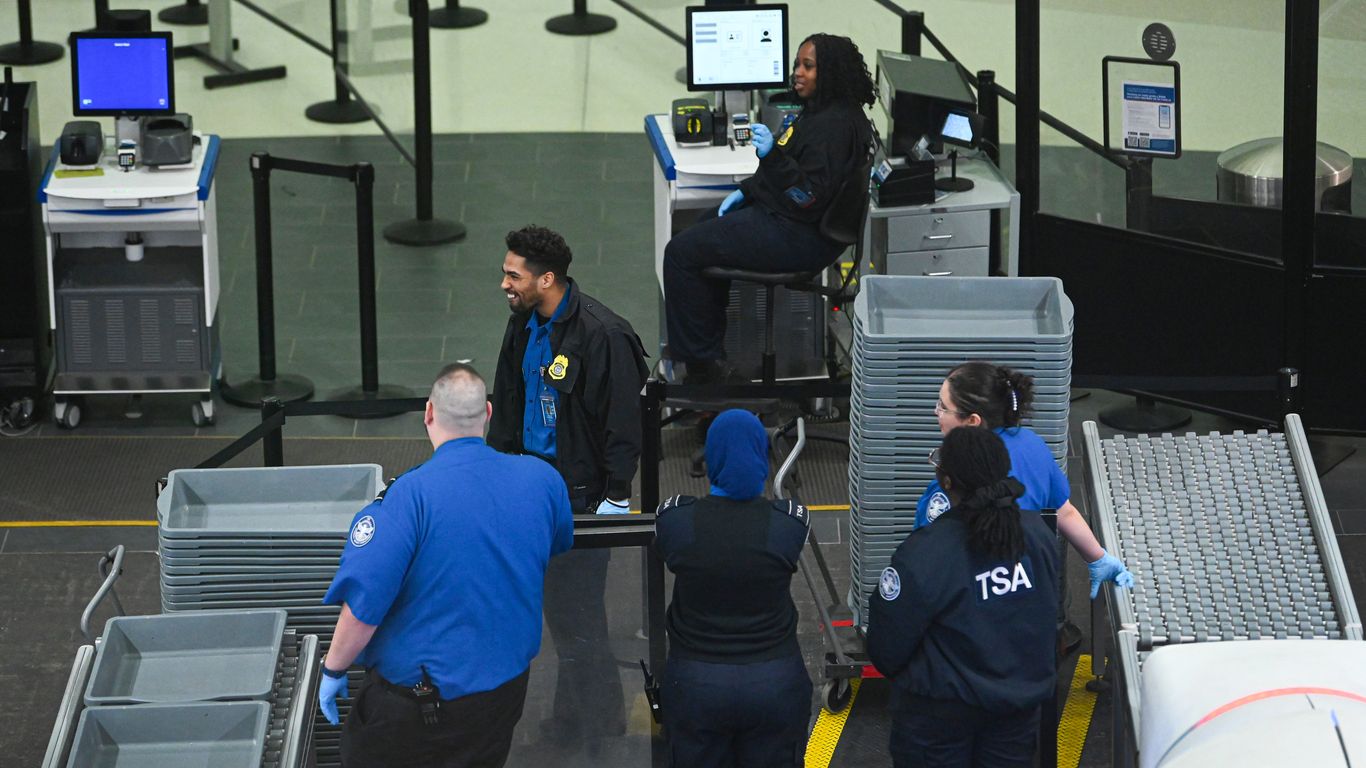
President Trump announced he will sign an order directing DHS Secretary Markwayne Mullin to immediately pay TSA agents, bypassing Congress. The action aims to alleviate widespread airport delays linked to the DHS shutdown but undercuts Senate negotiations to end the shutdown now in its second month. It should reduce near-term operational risk for travel and passenger flows while increasing political and legislative uncertainty ahead of elections.
Operational relief at U.S. airports, even if temporary, shifts a tail-risk from 'flight cancelation cascades' to a shorter-duration service disruption problem; that structurally reduces near-term rebooking/irregularity costs for network carriers by an amount we estimate in the low hundreds of millions per week industry-wide, improving cash flow visibility over the next 2–8 weeks. Ancillary beneficiaries are booking platforms and airport retail, where passenger throughput is the primary revenue lever; a durable improvement through peak travel months would convert a staggered recovery into a concentrated revenue uplift for Q2–Q3.
The political/legal vector is the dominant second-order risk: executive workarounds that relieve immediate operational pain also remove leverage for a negotiated, legislative resolution — increasing the probability the underlying funding stalemate persists for months. That raises a bifurcated outcome set: (A) a 2–8 week operational bump if courts/administration allow the measure to stand, or (B) renewed disruption and negative sentiment into the fall if the workaround is enjoined or prompts escalation, which would disproportionately hurt smaller carriers with thin liquidity buffers.
Capital-allocation implication: players with low marginal cost of schedule recovery (Southwest-style point-to-point operators) capture outsized benefit from restored throughput versus legacy hub carriers that absorb higher disruption costs; equipment and systems vendors for checkpoint screening win on any multimonth commitment to harden screening, but that upside is delayed 3–12 months and contingent on formal contracts and budgets.
AI-powered research, real-time alerts, and portfolio analytics for institutional investors.
Overall Sentiment
neutral
Sentiment Score
0.00
