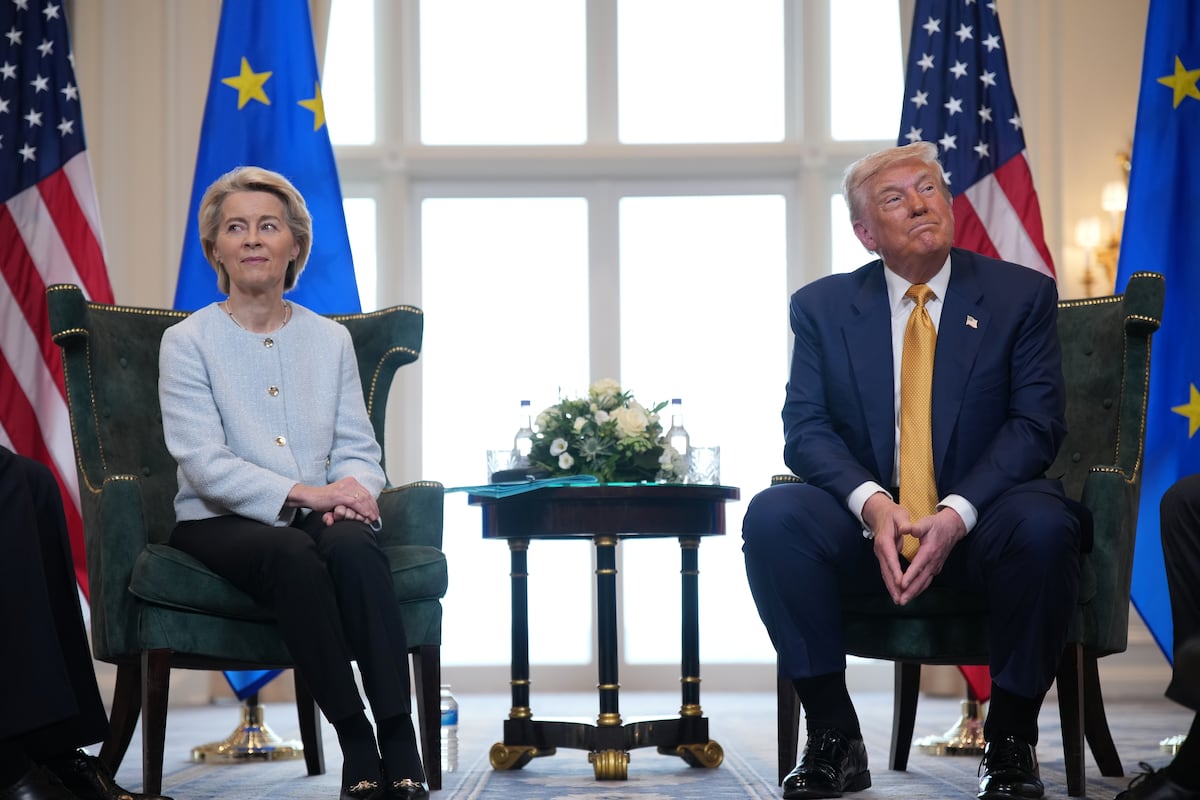
Escalating U.S. actions under the Trump administration — from public comments about acquiring Greenland and sanctions on former EU commissioner Thierry Breton to a new National Security Strategy targeting the EU — have put Europe on heightened alert about a potential withdrawal of U.S. security guarantees. Europe spent roughly €380 billion (~$447 billion) on defence in 2025 but remains operationally dependent on U.S. capabilities (intelligence, air/space assets, and software), with 50% of NATO European equipment purchases sourced from the U.S. in 2022–24; analysts estimate an additional ~$1 trillion over 25 years would be needed to replace U.S. conventional capabilities. Congressional legislation limiting U.S. troop drawdowns in Europe and a modest $800 million Ukraine aid allocation partially counterbalance political risk, but Reuters reporting that the Pentagon pressed Europe to assume conventional defence by 2027 underscores near-term strategic uncertainty that should drive reassessments of defence exposure and European sovereign/defence supply‑chain risk for investors.
Market structure: A sustained U.S.–Europe political rupture structurally benefits aerospace & defense primes (Lockheed LMT, Northrop NOC, RTX RTX; ETF ITA) and short-term US tech oligarchs protected by Washington’s pressure on Brussels; European sovereigns and tech/regulatory platforms (European cloud providers, smaller EU contractors) are losers due to “kill‑switch” risk and dependency on US software/hardware. Expect pricing power for large defense contractors as EU procurement demand jumps (EU defense spend rose ~€260bn→€380bn in 2022–25, implying multi‑year procurement growth of ~40%).
Risk assessment: Tail risks include unilateral US military action or expanded sanctions on EU officials, software update denial for platforms (operational kill‑switch), and a disruptive Russian escalation — low probability but >10% over 12 months given current rhetoric. Immediate (days) risks: FX and equity risk-off (EUR down, bunds volatile); short term (3–6 months): procurement announcements, Pentagon/EU budget negotiations; long term (3–10 years): ~$1tn+ extra European defense capex and industrial consolidation.
Trade implications: Tactical trades should target defense exposure, USD vs EUR, and energy/gold tail hedges. Buy defense equities/ETFs and 6–12 month call structures; initiate a short EURUSD / long USD leg via forwards or 3‑month puts; buy oil/gold as geo‑risk hedges. Hedge concentration risk with small put protection and size positions 1–3% NAV.
Contrarian angles: Consensus expects total US withdrawal; that’s overstated — Congress and the Pentagon still act as constraints, making a chaotic hard break unlikely in <12 months. Mispricings: select European defense primes (Airbus EADSY, Leonardo LDO.MI) and niche EU system integrators are underowned and should benefit from coalition procurement and consolidation. Unintended outcome: faster EU consolidation could create 30–50% upside in winners over 24–36 months while increasing sovereign bond issuance pressures.
AI-powered research, real-time alerts, and portfolio analytics for institutional investors.
Request DemoOverall Sentiment
strongly negative
Sentiment Score
-0.60
