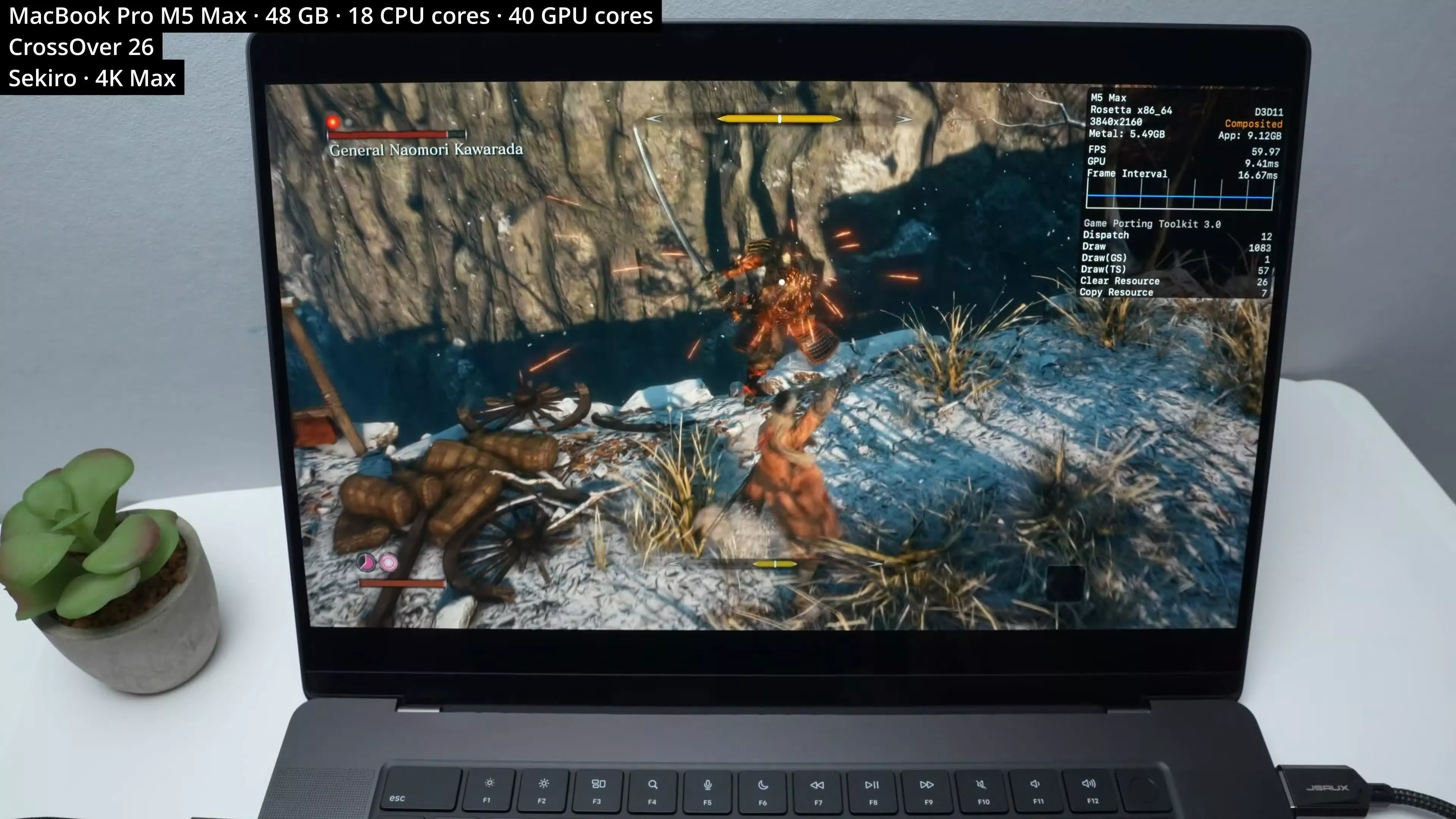
New MacBook Pro models with M5 Pro (20-core GPU) and M5 Max (40-core GPU) consistently hit ~60 fps in multiple AAA titles (e.g., Cyberpunk 2077 ~60fps upscaled 1440p on M5 Pro; M5 Max ~60fps upscaled 4K; Baldur's Gate 3 60fps at native 4K max). Compatibility-layer advances (Crossover, Vulkan hacks) and mods expand playable Windows-only games, although some titles still fail or have graphical issues (e.g., Death Stranding 2 water rendering, missing support for later Vulkan games). Ray tracing remains a clear weakness that substantially reduces performance, limiting MacBooks' parity with dedicated gaming GPUs despite meaningful gains in real-world gaming performance.
Apple’s capability uplift in GPU-bound workloads is a structural lever that shifts competitive dynamics in mobile gaming laptops and creative-workstation convergence. Expect marginal share to shift away from Windows OEMs in the premium thin-and-light segment (the cohort that trades off raw ray-tracing for battery, thermals, and silence) — this favors vendors tied to Apple’s silicon supply chain (TSMC, advanced packaging suppliers, and unified-memory suppliers) while compressing the addressable market for mobile discrete GPUs.
The next 3–12 months are critical: developer signal (ports, engine support for Metal) and Apple-facing marketing will convert curiosity into upgrade demand, but the longer-term prize (3+ years) is whether publishers re-architect pipelines for Apple APIs — without that, the gains plateau. Downside catalysts that would reverse the trend quickly include a new generation of mobile discrete GPUs with superior ray-tracing/per-watt, major game engines deprioritizing macOS ports, or supply constraints at advanced fabs that limit unit availability.
From a portfolio construction view, this is a slow-bleed competitive shift rather than an immediate market-disrupting event: own the supply-side growth that scales with Apple unit and ASP expansion, hedge consumer cyclicality, and trade around developer/catalyst windows (WWDC, major port announcements). Position sizes should be asymmetric — concentrated on suppliers with idiosyncratic upside and small, option-like exposure to the hardware thesis rather than large directional bets against entrenched GPU incumbents.
Contrarian check: the market may overestimate short-term gaming cannibalization of Windows — culture, modding ecosystems, multiplayer parity, and ray-tracing expectations keep a large cohort on Windows. Hence, favor calibrated, duration-aware exposure that monetizes Apple’s improving TAM without assuming wholesale displacement of discrete-GPU ecosystems.
AI-powered research, real-time alerts, and portfolio analytics for institutional investors.
Request DemoOverall Sentiment
mildly positive
Sentiment Score
0.25
Ticker Sentiment
