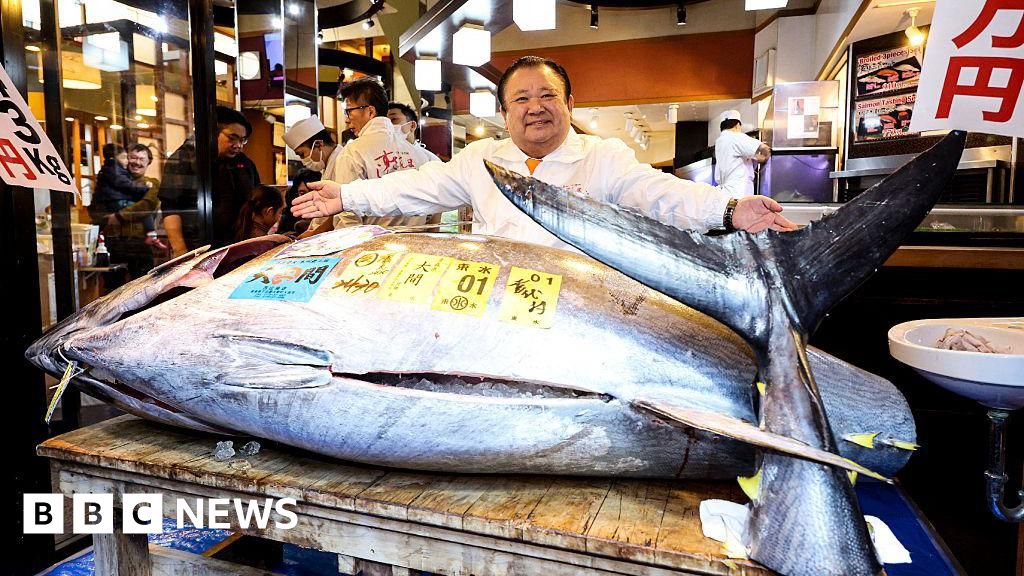
At Tokyo's Toyosu fish market the first auction of the year saw a 243 kg bluefin tuna sell for a record 510.3 million yen (~$3.2m) to Kiyomura Corp, operator of the Sushi Zanmai chain. The headline transaction — another high-profile New Year bid by Kiyoshi Kimura — delivers marketing value and premium menu inventory to the buyer, highlights robust high-end demand for bluefin, and generates tourism and PR benefits for Japan's restaurant and seafood sectors, but is unlikely to move broader financial markets.
Market structure: The headline auction is a branding/PR event that disproportionately benefits well-capitalised branded sushi chains and upstream processors rather than changing broad wholesale markets. A 510.3m yen sale (vs 333.6m in 2019, +53%) signals strong high-end willingness-to-pay but is concentrated in luxury demand; expect transient footfall and menu-priced premium capture rather than broad supply re-pricing.
Risk assessment: Near-term (days–weeks) this is a marketing tailwind for winners; short-term (1–6 months) margins can improve if chains pass premium to customers, but long-term (years) overfishing or regulatory quota cuts (ICCAT/Japanese Fisheries Agency) are low-probability, high-impact tails that could spike input costs >20%. Hidden dependency: auction-driven demand is elastic and reputational—sustainability campaigns or a 5–10% drop in foot traffic would reverse gains quickly.
Trade implications: Direct plays favor listed seafood processors (Maruha 1333.T, Nippon Suisan 1332.T) and large sushi operators (Sushiro 3563.T, Kura 2695.T) with small, tactical weights (1–2%), horizon 3–9 months. Options: prefer 3-month call spreads on processors to express a controlled view if wholesale tuna indices rise >10%; pair trade overweight branded chains vs underweight small independents/family-dining.
Contrarian angle: Consensus extrapolates PR auction to commodity fundamentals—historical parallels (record Kobe beef/lobster auctions) show limited durable price impact. The mispricing: short-lived demand spikes and potential margin compression if wholesale bluefin costs rise >5% and cannot be passed on; monitor quota announcements and wholesale tuna price moves (>10%) as catalysts to re-rate positions.
AI-powered research, real-time alerts, and portfolio analytics for institutional investors.
Request DemoOverall Sentiment
mildly positive
Sentiment Score
0.25
