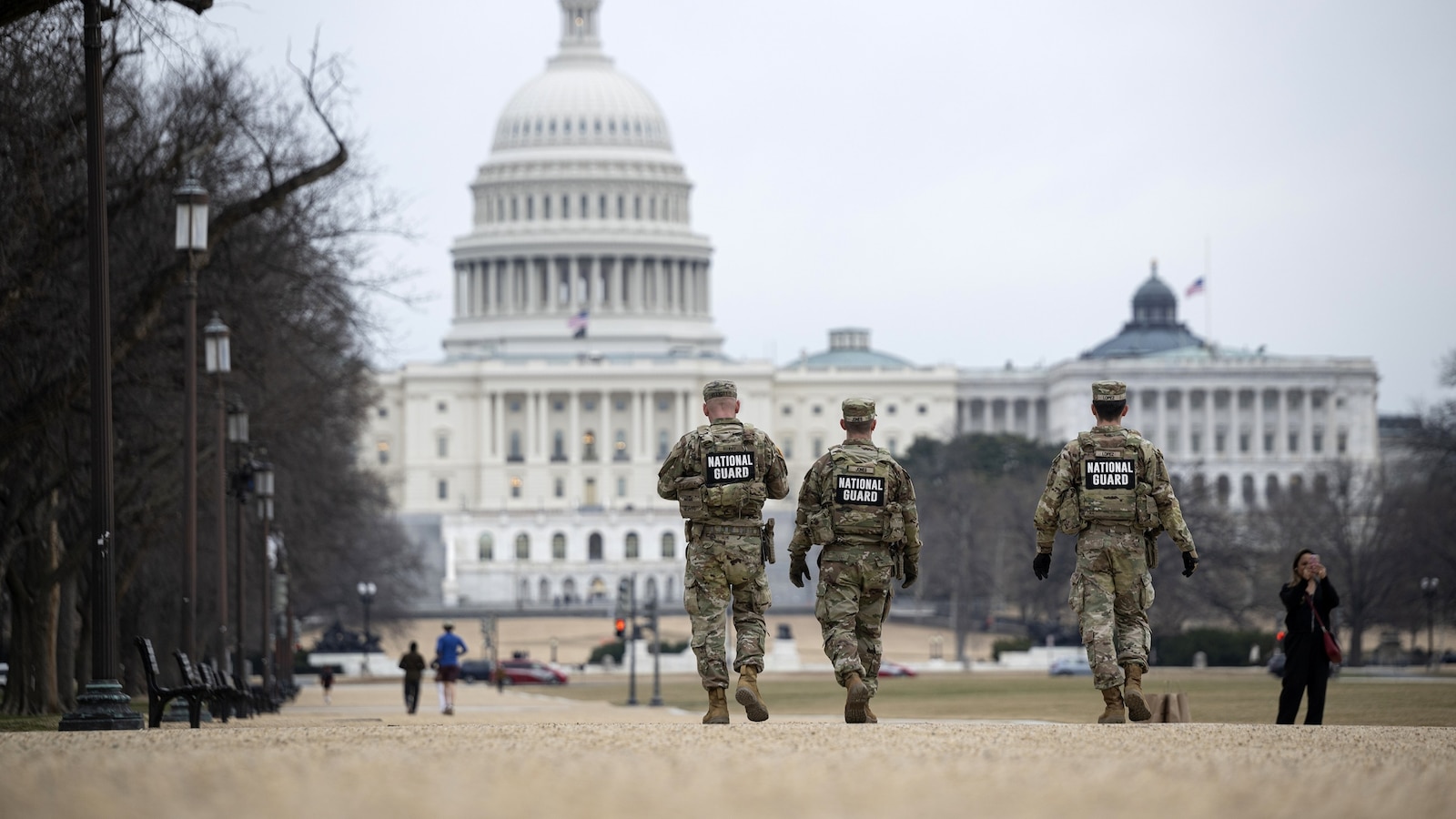
Federalized National Guard troops — about 2,400 members, largely drawn from Republican-led states — will remain deployed in Washington, D.C., through the end of the year under a mission called "Make DC Safe and Beautiful," conducting armed patrols in downtown Metro stations, the National Mall and performing routine civic tasks. The deployment, enabled by a different legal framework for D.C. and extendable at the president's discretion, follows the November shooting of two West Virginia guardsmen and underscores increased reliance on Guard units for domestic missions even as they sustain overseas commitments.
Market structure: A 2,400-person federally federalized Guard presence in DC (headline extension through 2026) creates small but tangible demand for federal security services, facilities maintenance and IT/security contractors rather than large-scale defense primes. Winners are mid-cap government services names (facility services, IT/security contractors) and local vendors in DC; losers are narrow-exposure hospitality/retail plays in downtown DC if perception of risk depresses foot traffic by >5–10% over a quarter. Pricing power is limited because most work flows through IDIQ/GSA vehicles, favoring incumbents with contract vehicles already in place.
Risk assessment: Tail risks include a major attack or civil unrest that triggers a multi-month surge in spending (high-impact, low-probability) or conversely legal/municipal pushback that cancels local contracting — both could move pockets of revenue by tens of millions per vendor. Immediate (days) market impact is negligible; short-term (weeks–months) is where contract awards and small revenue bumps appear (order-of-magnitude $5–100M); long-term (quarters–years) depends on federal budget decisions and judicial rulings. Hidden dependencies: whether work is procured at federal vs. state NG level (GSA/IDIQ eligibility) and news catalysts (new incidents, GAO audits, White House budget memo).
Trade implications: Favor selective, small-weight long positions in companies with proven GSA/IDIQ access: CACI (+1–2% weight, 3–9 month horizon) and Leidos (LDOS, +1–2%, 3–9 months) and ABM (ABM, +1%, 3–12 months) for facilities/landscaping/trash niches; pair with a tactical short of DC-centric hotel REITs (HST or MAR, −0.5–1% weight) to capture local demand drag. Options: buy 3–6 month ATM calls sized to 0.5% notional on CACI or LDOS to lever expected contract-news; hedge portfolio tail-risk with +1% allocation to 2–5Y Treasuries if unrest escalates.
Contrarian angle: The market will over-index to defense primes (LMT/NOC/GD) despite domestic NG work being a tiny share of their revenue; avoid adding large positions there unless Congress signals new domestic defense spending >$1B. Historical parallels (post-9/11 local security spending) show mid-cap government services compound faster than primes in initial 6–12 months. Unintended consequence: increased litigation/public pressure could flip awards or extend timelines, turning a short-term revenue win into a reputational/headwind risk for contractors.
AI-powered research, real-time alerts, and portfolio analytics for institutional investors.
Request DemoOverall Sentiment
neutral
Sentiment Score
0.00
