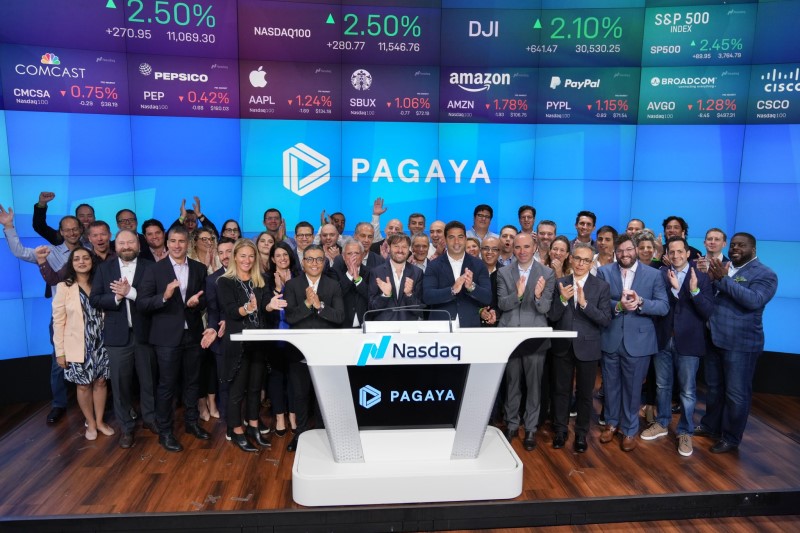
Canaccord reiterated a Buy rating on Pagaya Technologies with a $32 price target versus a current share price of $12.87, citing steady quarterly execution, improved funding flexibility, and stronger profitability. Q1 2026 EPS came in at $0.73 vs. $0.20 expected, a 265% surprise, while revenue was $318 million versus $323.63 million consensus; the company also logged its fifth straight quarter of GAAP profitability. EBITDA rose 18% and GAAP net income increased 47%, with the firm highlighting tighter credit standards and expanding securitization options.
Pagaya is transitioning from a cyclical originator to a more durable structured-credit platform, and the key second-order effect is not just margin stabilization but funding resilience. The move toward asset-backed securities, a first AAA rating, and resecuritization capability should lower dependence on fragile whole-loan buyers, which matters most when private credit spreads widen and competitors are forced to pull back. That creates a classic stress-market winner: when funding tightens, the stronger platform can actually widen share by originating into a more constrained supply chain.
The market is likely underestimating how quickly operating leverage can compound once loss assumptions are fully reset. If the credit box is now tighter and retention impairments are normalizing, near-term headline growth may look less exciting, but the tailwind is that future quarters should have less earnings volatility and better repeatability, which should compress the discount rate applied to PGY. The biggest hidden risk is that improved performance may encourage looser underwriting just as consumer credit lags broader macro by several quarters; that would show up first in delinquency migration before it hits reported EPS.
Consensus appears to be treating this as a simple earnings beat/re-rating story, but the more interesting angle is that PGY is increasingly a beneficiary of dislocation in private credit markets and may continue taking wallet share from smaller fintech lenders with weaker funding access. The equity can work higher, but the cleaner expression may be the capital structure: if equity rerates faster than fundamental de-risking, the optionality in the warrant can offer higher convexity with defined downside. Near-term catalysts are another funding partnership, a further ratings upgrade, or another quarter of low-loss execution; the main reversal trigger is a consumer credit turn or any sign the ABS bid weakens again.
AI-powered research, real-time alerts, and portfolio analytics for institutional investors.
Request DemoOverall Sentiment
moderately positive
Sentiment Score
0.55
Ticker Sentiment
