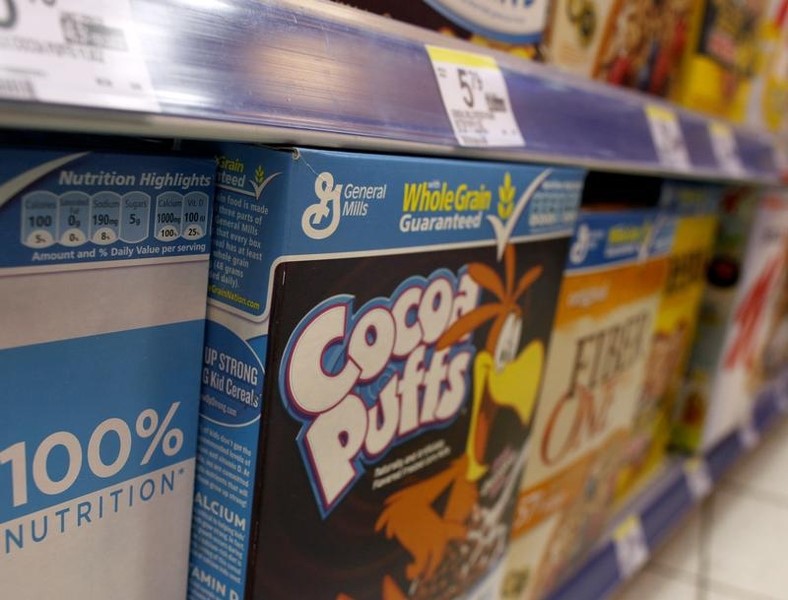
General Mills reported Q3 adjusted EPS $0.64 vs. $0.73 consensus (miss by $0.09) and revenue $4.4B essentially in line with estimates but down 8% YoY; shares fell ~1.2% after the print. The company reaffirmed FY26 guidance calling for organic net sales to decline 1.5%–2% and adjusted operating profit and adjusted diluted EPS to fall 16%–20% in constant currency; Q3 adjusted operating profit was $547M, down 32% in constant currency. Management cited lower volume, unfavorable price/mix and higher input costs as drivers but expects a significant sequential improvement in Q4 due to easier comps, a 53rd week and share gains.
General Mills’ setup reads like a classic operating-leverage short: modest top-line friction transmits into amplified margin sensitivity because fixed manufacturing, logistics and SG&A loads don’t move with near-term volume. That magnifies the impact of commodity and packaging cost moves — a 1-3% swing in pounds or input cost can translate into double-digit percent swings in reported operating profit, making headline quarter-to-quarter volatility a poor read on durable brand health. The company’s portfolio actions (SKU pruning, targeted investment and divestitures) create asymmetric outcomes across categories: brands that win shelf and distribution will see margin recovery faster than headline sales, while commodity-exposed, lower-price categories are where private-label and nimble challenger brands can steal share. On the supply-chain side, any re-acceleration in wheat/sugar/dairy or freight inflation will ricochet through margins quickly; conversely, commodity disinflation will drive outsized margin recovery because of the fixed-cost base. Key catalysts and risks are concentrated and time-staged: retailer inventory flows and promotional cadence can swing reported results in weeks, commodity trajectories and packaging capacity resolve over quarters, and successful divestiture/tuck-in execution plays out over 6–18 months. Tail risks include a surprise commodity spike, an aggressive promotional response from competitors, or execution slippage on cost programs; all would materially widen downside versus consensus. That asymmetric dynamic creates clean tradeable exposures: short-duration event trades around retail cadence and guidance near-terms, and medium-duration directional views that bet on either a weak execution path or an over-punished valuation if costs roll over and share gains convert to profits. Position sizing and option structure are essential — this is a volatility and execution story, not a binary product-failure thesis.
AI-powered research, real-time alerts, and portfolio analytics for institutional investors.
Request DemoOverall Sentiment
moderately negative
Sentiment Score
-0.55
Ticker Sentiment
