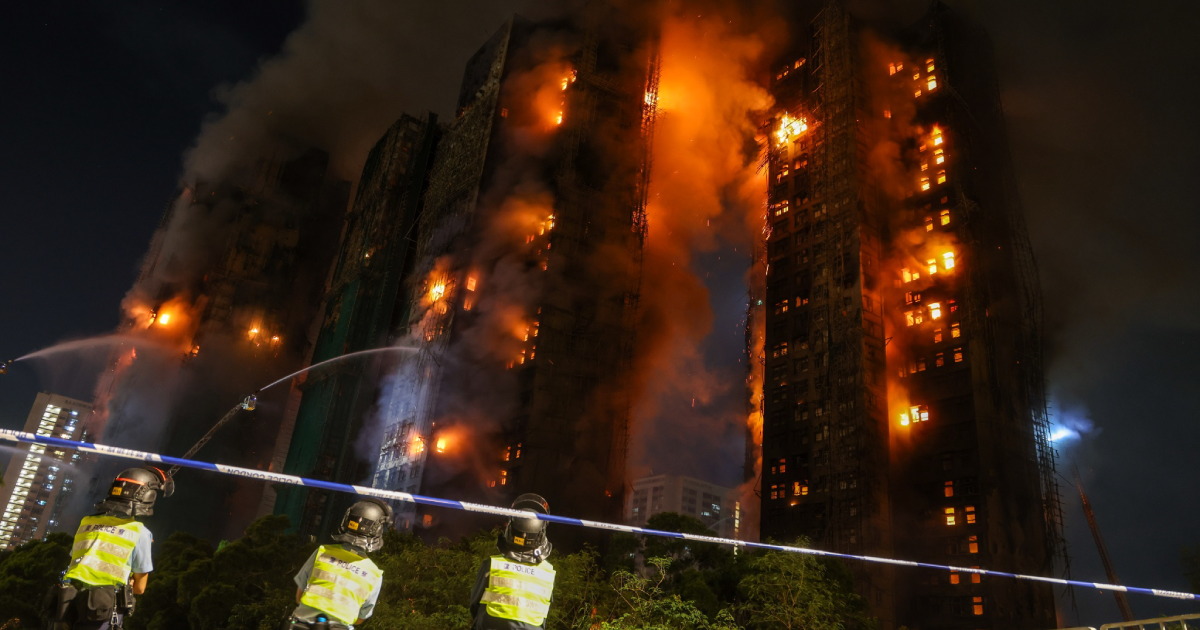
A catastrophic fire at Wang Fuk Court—an eight‑tower estate housing about 4,600 people undergoing a roughly HK$330 million ($42m) renovation—has killed more than 150 people with about 30 missing, triggering arrests of contractors and executives as investigators focus on substandard scaffolding nets and styrofoam window boards. Residents had repeatedly warned about the materials and bidding process involving Prestige Construction and Will Power Architects; authorities say 2,300 rolls of substandard netting were purchased at HK$54/roll while compliant rolls were used to pass inspections. The disaster intensifies scrutiny of Hong Kong building regulation, governance and anti‑corruption enforcement, risks reigniting political unrest, and could weigh on investor sentiment toward the territory’s housing sector and regulatory reliability.
Market structure: The immediate losers are small renovation contractors, low‑margin scaffolding/net suppliers and listed small‑cap construction names; expect 10–30% downside idiosyncratically for exposed SMEs and 5–15% weakness across HK developer midcaps as risk premia widen over 1–3 months. Winners include certified fire‑safety equipment makers, large well‑capitalized developers (balance‑sheet advantage) and legal/restructuring advisers who will capture remediation spend; compliance/inspection demand should raise tender prices 5–10% over 12–24 months, favoring scale.
Risk assessment: Tail risks include a broad regulatory clampdown (mandatory replacement of non‑compliant materials across up to ~29,000 older buildings) creating multi‑billion HKD remediation liabilities, and sizable class‑action or criminal exposures to contractors/consultants within 30–90 days; worst‑case litigation could lead to bond covenant breaches for small contractors. Near term (days–weeks) expect equity/credit volatility; medium term (3–12 months) policy responses and ICAC findings will determine liability allocation; long term (1–3 years) structural capex reallocation toward compliance.
Trade implications: Opportunistic shorting of small/levered HK construction contractors and long exposure to large, cash‑rich landlords is preferred; hedge HK equity beta with HSI puts during the 30–90 day enquiry window. Use options to express views: buy 1–3 month put spreads to limit capital at risk while capturing volatility; size trades modestly (1–3% NAV each) and use strict stops given political tail risk.
Contrarian angles: Consensus focuses on politics and social unrest, underweighting the structural demand boost for certified materials and safety retrofits — a backloaded capex cycle could lift margins for compliant suppliers in 6–18 months. The market may overprice systemic contagion; if ICAC findings concentrate blame on a few firms, large developers with low leverage (e.g., net gearing <20%) could re‑rate within 6–12 months by 5–15% as fear fades.
AI-powered research, real-time alerts, and portfolio analytics for institutional investors.
Request DemoOverall Sentiment
strongly negative
Sentiment Score
-0.60
