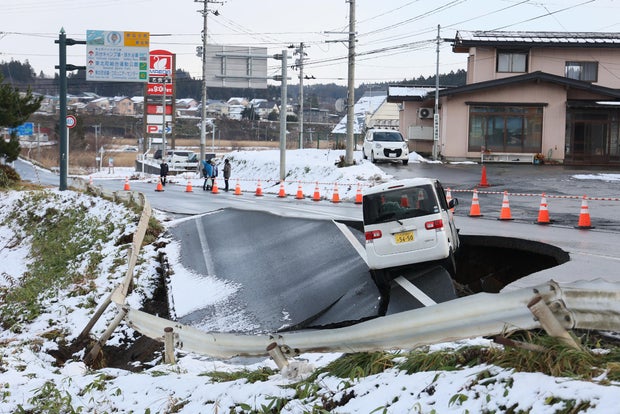
Japan issued a megaquake advisory after a magnitude-7.5 earthquake struck off Aomori, causing 34 mostly mild injuries and localized damage, and warned an offshore megaquake could produce up to a 98-foot tsunami, kill as many as 199,000 people and cause up to ¥31 trillion (~$198 billion) in economic losses. The Japan Meteorological Agency said the advisory is not a time-specific prediction and estimates only about a 1% chance of a magnitude-8-or-larger event, but it highlighted an elevated risk in the coming week and cited the 2011 sequence in which a M7.3 preceded a M9.0 temblor; the alert covers 182 municipalities from Hokkaido to Chiba. Officials are urging residents to prepare emergency kits and evacuation plans and local governments are inspecting relief stocks; market participants should monitor potential near-term disruptions to coastal infrastructure, supply chains, tourism and insurance exposure given the government’s loss estimates and the economic impact seen after last year’s advisory.
A magnitude-7.5 earthquake struck off Aomori, northern Honshu, causing 34 mostly mild injuries and localized damage to roads and buildings and prompting the Japan Meteorological Agency to issue a megaquake advisory covering 182 municipalities from Hokkaido to Chiba. The advisory is explicitly not a time-specific prediction; JMA and officials estimate only about a 1% chance of a magnitude-8-or-larger event but note an elevated risk in the coming week and cited the 2011 precedent in which a M7.3 foreshock preceded a M9.0 temblor two days later.
The Japanese government’s scenario planning quantifies potential exposure: a Hokkaido–Sanriku offshore megaquake could generate up to a 98‑foot tsunami, cause as many as 199,000 fatalities, destroy up to 220,000 buildings, and inflict up to ¥31 trillion (~$198 billion) in economic damage, with tens of thousands at risk of hypothermia in winter. Authorities are urging preparedness (emergency kits, secured furniture, evacuation plans) and municipalities are inspecting relief stocks; last year’s Nankai Trough advisory produced notable demand shocks and service cancellations.
For markets, the near-term risk is operational and demand-side disruption—coastal infrastructure, ports, tourism, local retail and insurance/reinsurance exposures—rather than a confirmed macro shock; the evolving on-the-ground damage assessments, insurance claims and any transport or port closures will determine sector-level impacts and potential fiscal response.
AI-powered research, real-time alerts, and portfolio analytics for institutional investors.
Request DemoOverall Sentiment
moderately negative
Sentiment Score
-0.45
