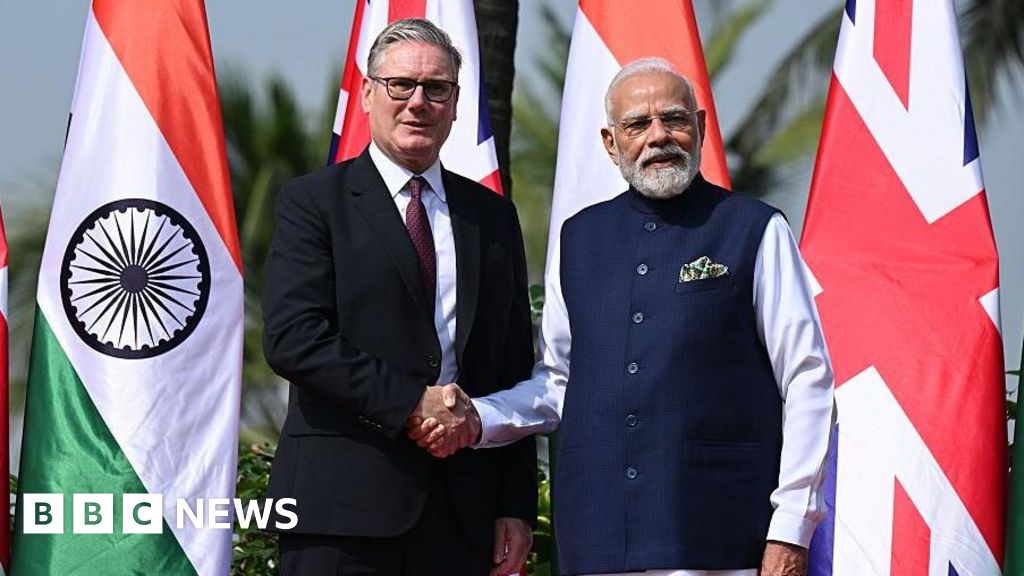
Sir Keir Starmer lauded the UK-India trade deal as a significant economic "launchpad" following his meeting with Prime Minister Modi and a substantial UK trade delegation in Mumbai. The deal, described as India's most ambitious, aims to bolster UK leadership in sectors like tech and life sciences, capitalizing on India's projected growth to become the third-largest economy by 2028. Key financial outcomes include an already realized £1 billion in UK investment and 7,000 jobs, with the UK reducing tariffs on Indian goods such as clothing and seafood, while India lowers duties on Scotch whisky, luxury cars, and medical devices. Furthermore, new UK university campuses in India are expected to generate an additional £50 million for the economy.
Sir Keir Starmer has lauded the UK-India trade deal as a significant "launchpad" for economic expansion, aligning with India's projected growth to become the world's third-largest economy by 2028. This agreement, described as India's most ambitious, aims to bolster UK leadership in key sectors including technology, life sciences, and renewable energy. This positive sentiment is reinforced by a general sentiment score of 0.75 and an optimistic tone.
The deal has already yielded tangible benefits, with £1 billion in UK investment and the creation of nearly 7,000 jobs. Strategic tariff reductions are central, as the UK will cut duties on Indian clothing, footwear, and seafood, while India will reduce tariffs on high-value British exports such as Scotch whisky, luxury cars, and medical devices, facilitating mutual market access.
Further strengthening economic ties, the approval of new UK university campuses in India, including Lancaster and Surrey, is expected to generate an additional £50 million for the UK economy. This expansion of educational services underscores a broader strategy to deepen bilateral relations and foster long-term talent development.
While the primary focus is economic, discussions also encompassed geopolitical issues like the Ukraine conflict and India's energy policy, reflecting the complex nature of the bilateral relationship. These broader considerations, though not directly financial, form part of the macro-environment influencing long-term trade stability and investor confidence.
AI-powered research, real-time alerts, and portfolio analytics for institutional investors.
Request DemoOverall Sentiment
strongly positive
Sentiment Score
0.75
Ticker Sentiment
