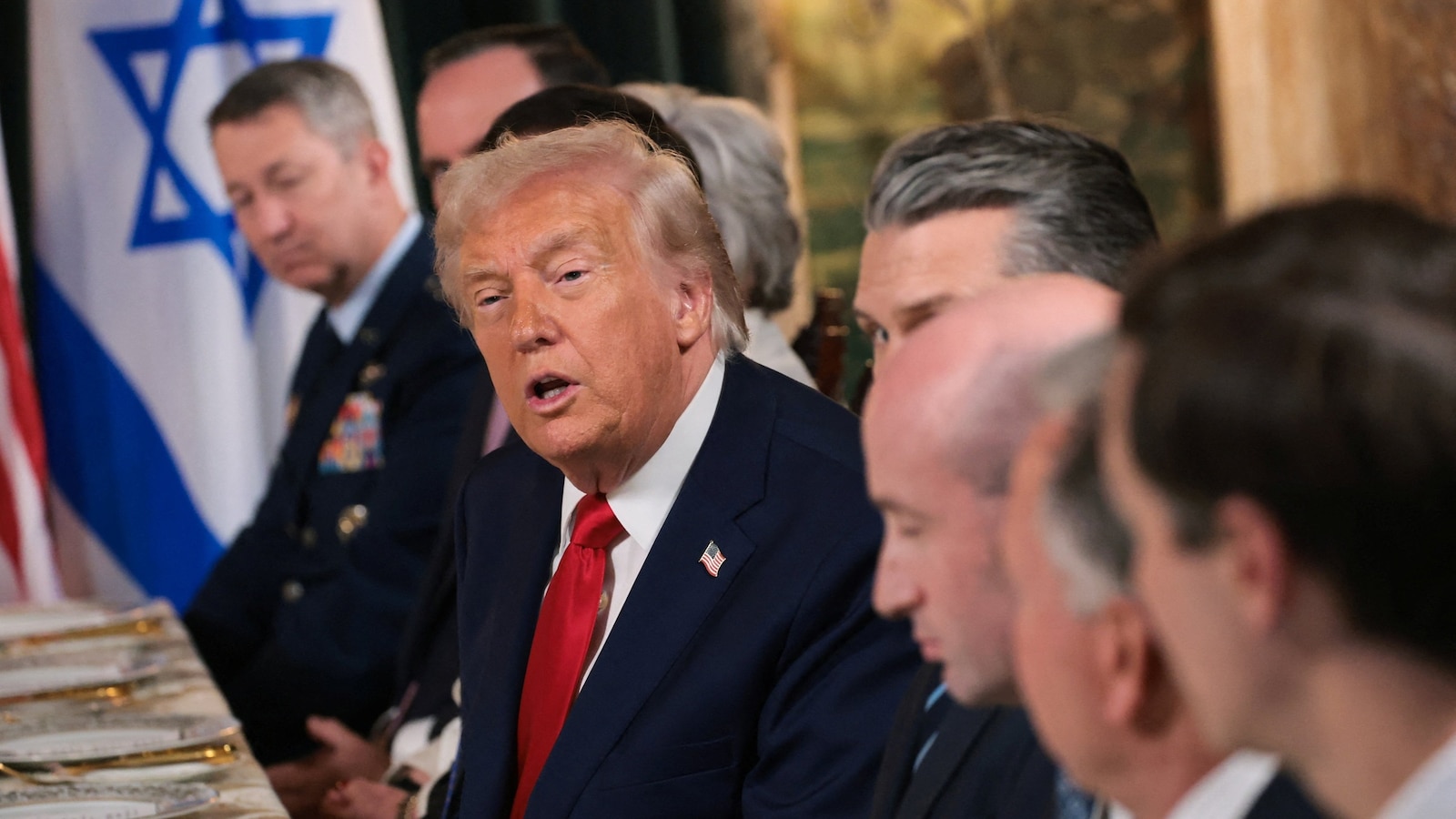
At Mar-a-Lago President Trump warned Iran and Hamas that the U.S. and Israel would use decisive military force if Iran rebuilds its nuclear/ballistic programs or if Hamas fails to disarm, and he signaled support for Israeli strikes; he reiterated prior claims that U.S. actions earlier in the year struck Iranian nuclear sites. The comments follow a June 12-day U.S.-Israel campaign that killed roughly 1,100 Iranians and hit nuclear and IRGC targets, retaliatory Iranian missiles that killed 28 in Israel, recent Iranian large-scale missile exercises, and an Iranian president saying Tehran faces a 'full-scale' war — developments that raise regional escalation risk and are likely to pressure FX (rial), defense exposure and energy-sensitive markets.
Market structure: Heightened U.S.-Iran/Israel tensions hands a near-term boost to defense primes (Lockheed LMT, Raytheon RTX, Northrop NOC) and oil producers (XOM, CVX) while pressuring airlines/cruise (UAL, CCL), EM equities/bonds (EEM, EMB) and regional tourism. Pricing power shifts to missile/ISR suppliers and reinsurers; energy market could price a geopolitical premium of $5–$15/bbl if shipping risks rise materially. Cross-asset: expect USD strength (UUP +3–5%), gold upside (GLD/GDX +5–12%), Treasury safe-haven demand pushing 10y yields down ~10–30bps, and equity implied volatility spikes +25–50% in weeks.
Risk assessment: Tail risks include (1) direct US/Iran kinetic escalation (Strait of Hormuz closures reducing 0.5–1.5 mb/d), (2) major cyberattacks on energy/financial infrastructure, and (3) full-scale sanctions choking remaining Iranian oil exports. Timing: immediate days for volatility spikes, 1–3 months for oil/gold re-pricing, 3–12 months for defense budget/contract effects. Hidden dependencies: insurance/shipping rate feedback loops, EM FX repatriation, and Fed policy reaction to inflationary shock could reverse safe-haven flows.
Trade implications: Tactical allocation: initiate 2–3% long positions in LMT and RTX with 3–6 month horizons, and 2% long in GDX (gold miners) as a hedge; buy 3-month Brent-linked calls (or XOM call spreads) if Brent > $90 to capture nonlinear upside. Pair trades: long LMT vs short UAL (2%/2%) to express defense vs travel divergence. Options: buy 30–60 day put protection on EM exposure (EMB or EEM) and 3-month 25–35 delta call spreads on RTX to limit premium spend.
Contrarian angles: The market may overpay for large-cap defense while overlooking small-cap missile/subsystem suppliers and cyber names (PANW, CRWD) offering higher forward earnings leverage; consider selective long in these if prime contractors rally >10%. Historical parallel: 1990 Gulf War drove a sharp oil spike then mean reversion over 6–12 months—therefore size energy longs cautiously and trim into rallies. Watch triggers: add to oil/defense longs if Brent > $95 or VIX rises >+40% intraday; lighten if oil falls >15% from peak or no kinetic escalation within 90 days.
AI-powered research, real-time alerts, and portfolio analytics for institutional investors.
Request DemoOverall Sentiment
strongly negative
Sentiment Score
-0.70
