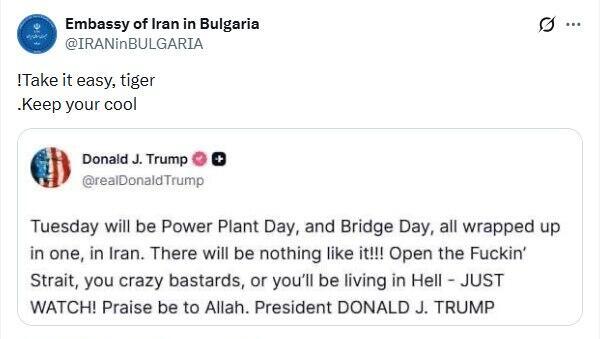
Key event: U.S. President Donald Trump's profane, threatening social-media post about Iran — including orders to 'Open the Strait' and threats against bridges and power plants — prompted coordinated reactions from Iranian embassies worldwide, some urging invocation of the 25th Amendment and warning of war-crime implications. The episode raises the risk of heightened geopolitical tensions around the Strait of Hormuz and critical infrastructure, creating potential upside volatility in energy and defense-related markets, though no kinetic escalation has been reported.
Social-media-driven diplomatic taunting functions as a low-cost amplifying mechanism that raises short-term political risk without committing actors to kinetic escalation. That dynamic tends to push two distinct market moves in the near term: a volatility spike in risk-sensitive assets (oil, EM FX, regional equities) over days-to-weeks, and a more persistent rerating of defense and security equities over quarters as governments accelerate deterrence and information-security spending.
Domestically, signaling aimed at fomenting institutional friction increases the probability of headline-driven policy risk around constitutional and executive-function debates; this can compress risk appetite for cyclical/consumer names and lift assets that hedge geopolitical uncertainty. Expect the knee-jerk bid to be strongest in large-cap defense primes and niche cyber firms, but attenuated if market participants perceive the activity as political theater rather than credible military escalation.
Second-order supply-chain effects are subtle but real: insurers/reinsurers and freight underwriters reprice Middle-East transit corridors within 48–72 hours after credible incidents, raising short-duration shipping costs and bunker pass-throughs that hit trade-sensitive industrials. The primary reversal catalyst is de-escalatory signaling from state actors or rapid on-the-ground clarification that removes ambiguity—once uncertainty is resolved, the largest P&L moves will reverse within one to four weeks.
AI-powered research, real-time alerts, and portfolio analytics for institutional investors.
Request DemoOverall Sentiment
mildly negative
Sentiment Score
-0.25
