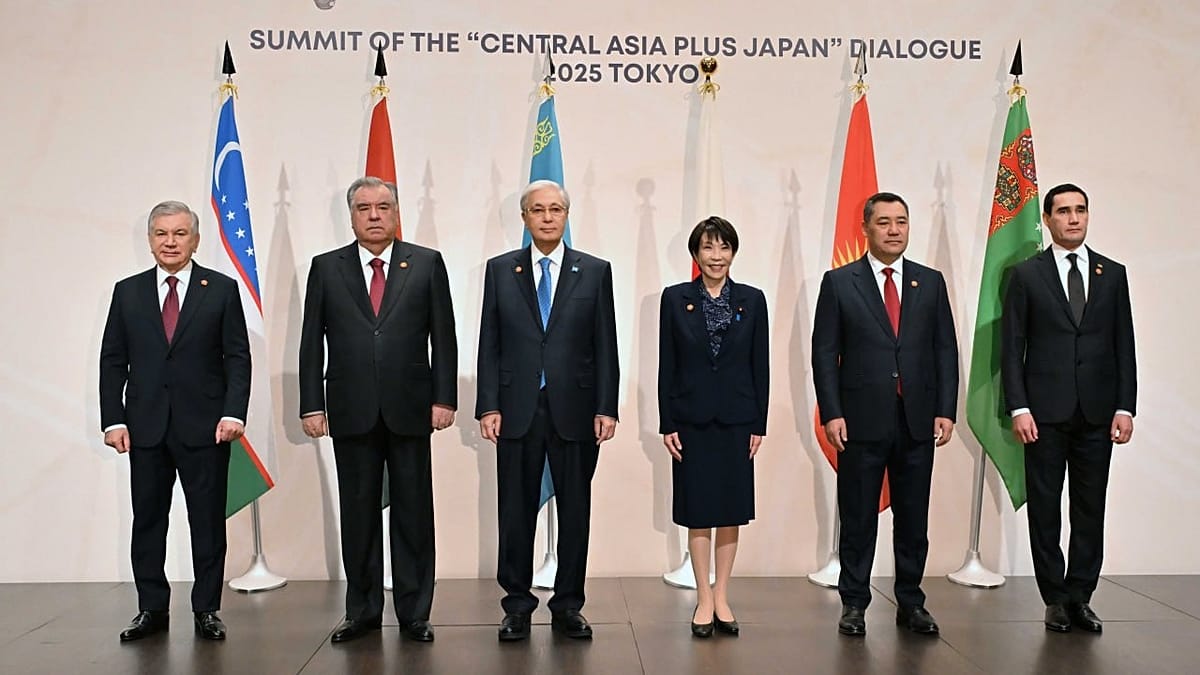
Japan and the five Central Asian presidents elevated the Central Asia + Japan dialogue to leaders' level and launched the CA+JAD Tokyo Initiative, targeting roughly 3 trillion yen (~€17.9bn) of business projects over five years focused on green/resilience, connectivity and human capital. The summit produced more than 150 signed documents and concrete deals — including two Uzbek solar plants with Sumitomo/Chubu/Shikoku backed by JBIC/NEXI, IT and medical investments by Toyota Tsusho and Sojitz, and critical-minerals projects with JOGMEC — highlighting increased Japanese ODA, private-sector engagement and potential shifts in regional transport, energy and critical-minerals supply chains.
Market structure: Japan’s CA+JAD Tokyo Initiative (¥3tn over 5 years ≈ ¥600bn/yr or ~€3.6bn/yr) creates a multi-year procurement pipeline favoring Japanese EPCs, heavy-equipment suppliers, logistics integrators and critical-minerals developers while incrementally shifting Asia–Europe freight capacity toward the Trans‑Caspian “Middle Corridor.” Expect Japanese exporters (construction, power, digital infrastructure) and rare‑earth/uranium developers to capture disproportionate share of announced projects; incumbent Russia‑centric transit providers and unconsolidated local contractors are the principal near‑term losers.
Risk assessment: Tail risks include geopolitical pushback from Russia/China, project delays/FX shocks in Central Asian currencies, and sovereign-credit constraints that could halve expected project spend. Immediate risk (days–weeks): headlines/contract announcements driving headlines; short term (3–12 months): JBIC/NEXI financing approvals and FIDs; long term (1–5 years): construction, commodity supply response and potential oversupply in select minerals. Hidden dependencies: customs harmonisation, port capacity at Aktau, and skilled labour/tech transfer — any fail here amplifies schedule risk.
Trade implications: Tactical longs — Japanese EPCs and trading houses with Central Asia exposure (e.g., Komatsu 6301.T, Sumitomo 8053.T, Toyota Tsusho 8015.T, Sojitz 2768.T) and strategic longs in uranium (Cameco CCJ) and rare‑earth processors (MP Materials MP, Lynas LYC.AX). Use 6–18 month call spreads to capture contract roll‑outs; overweight Industrials/Materials and underweight Russia‑linked logistics and EU rail operators. Enter tranche over next 4–12 weeks; take profits on 25–40% moves or upon first round of project FIDs (~3–6 months).
Contrarian angle: Market likely underestimates institutionalisation risk — creation of AI, justice and training partnerships makes this more than one‑off infrastructure spending; that suggests durable demand for digital/skill services (cybersecurity, AI) not just metal and construction. Reaction is underdone for specialty miners and Japanese tech providers but overdone for short‑duration contractors without longterm financing lines; hedge positions against a 20–40% regional political shock and favour names with JBIC/NEXI backing.
AI-powered research, real-time alerts, and portfolio analytics for institutional investors.
Request DemoOverall Sentiment
moderately positive
Sentiment Score
0.45
