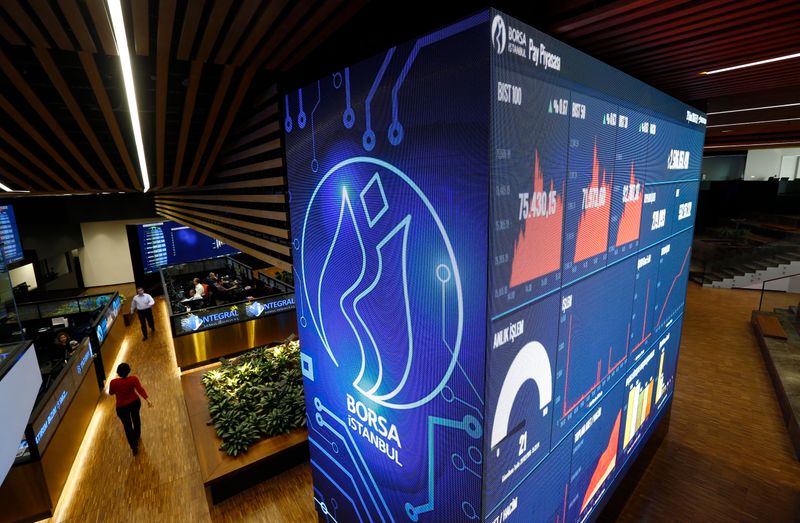
Turkey's BIST 100 fell 1.83% as Banking, Wholesale & Retail Trade and Chemical/Petroleum sectors led declines; decliners outnumbered advancers 452 to 157. Notable movers: Ral Yatirim +9.99%, Tekfen +5.18%, Aksa +4.07%; Kiler -6.91%, Sok Marketler -5.88%, ODAS -4.92%. Commodities and FX moved sharply: WTI May +4.42% to $94.31, Brent June +4.62% to $101.75, Gold June -2.48% to $4,471.97, USD/TRY 44.36 (+0.08%), EUR/TRY 51.35 (+0.09%), DXY futures 99.64 (+0.24%); geopolitical headlines on Iran add to near-term volatility.
A geopolitical-driven oil-price shock combined with renewed risk-off in emerging markets amplifies the classic EM transmission: higher energy import bills widen current-account deficits and force FX depreciation, which in turn magnifies balance-sheet mismatches in banks and corporates with unhedged FX liabilities. In Turkey specifically, this creates a two-speed market — firms with USD-linked revenues (engineering/exporters, some industrials) see cash-flow insulation while domestic-consumption names and FX-liability-heavy banks face margin and credit-pressure headwinds.
Second-order effects will show up through input-cost pass-through and working-capital stress: chemical/plastics and wholesale/retail supply chains will squeeze margins first, then curtail orders to upstream suppliers, potentially compressing capex and hitting commodity-intensive mid-caps over 3–6 months. Conversely, oil-linked producers and service providers with dollar contracts will generate incremental free cash flow that can be monetized quickly if managements prioritize deleveraging.
Catalysts to monitor on a sliding scale of urgency: near-term (days–weeks) — headlines from the Gulf, OPEC/voluntary cuts, and USD liquidity flows; medium-term (1–6 months) — central-bank FX intervention, sovereign issuance windows, and quarterly earnings that reveal FX mismatch; long-term (6–24 months) — chronic inflation and policy drift that could re-rate EM risk premia. Key reversal triggers are de-escalation, sudden large-scale SPR releases or an OPEC softening; any of those would rapidly compress risk premia and reverse currency moves.
Trading around this backdrop favors directional FX exposure sized with tails hedged, paired equity trades that capture dispersion, and protective credit positions against bank/corporate idiosyncratic defaults. Maintain tight event-driven stops and prefer structures (call spreads, CDS, pairs) that limit one-way tail risk while keeping upside convexity.
AI-powered research, real-time alerts, and portfolio analytics for institutional investors.
Request DemoOverall Sentiment
mildly negative
Sentiment Score
-0.18
