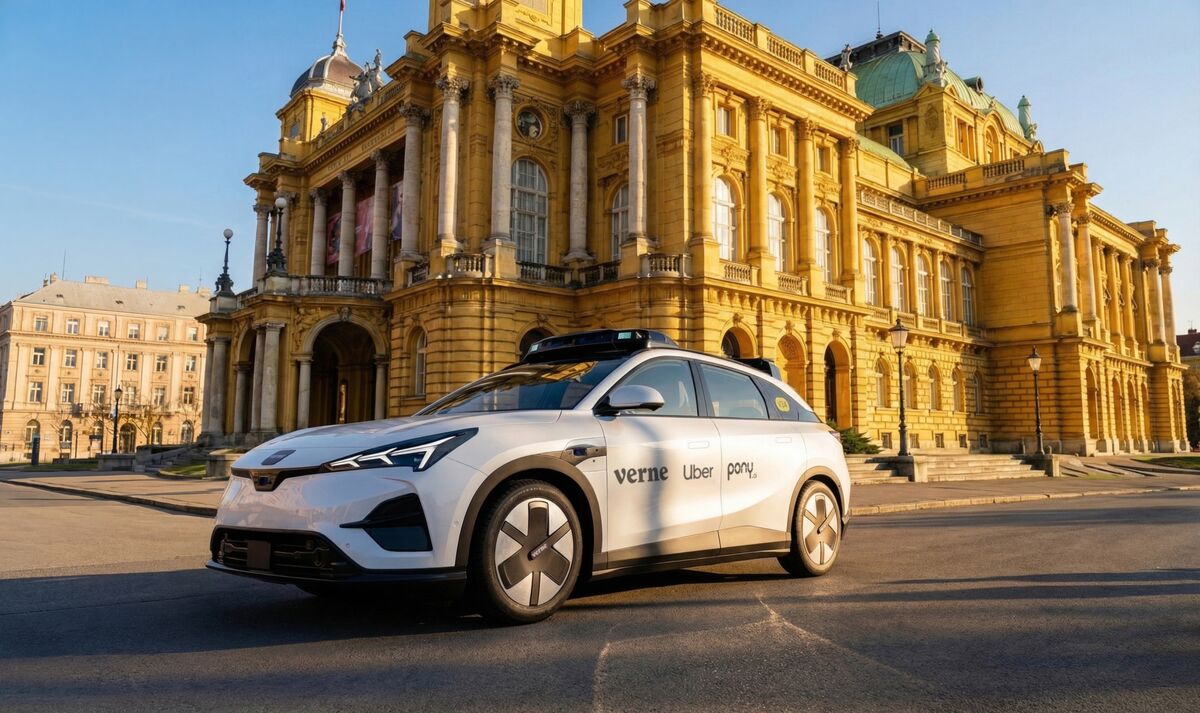
Pony AI and Uber have begun testing driverless robotaxis in Zagreb and plan a launch "soon" with local operator Verne, which will own and operate BAIC-manufactured Arcfox Alpha T5 vehicles fitted with Pony AI's self-driving technology. Vehicles will initially be offered on Verne's app and later bookable via Uber, marking an expansion of Pony AI/Uber partnership into Europe beyond prior Middle East deployments. The move advances Pony AI's commercial rollout and enhances Uber's mobility offerings, but this is an early-stage regional deployment with limited near-term revenue impact.
This is primarily a distribution and validation event, not a revenue inflection in isolation. The key value is optionality: Uber gains a low-cost channel to onboard rider demand for autonomous fleets without capital ownership, while OEMs and Tier-1 suppliers whose hardware/software get repeat production orders stand to see durable demand growth. Expect meaningful margin impact only once utilization, remote ops costs, and accident frequency converge to predictable levels — a multi-year process that benefits firms with scale in mapping, compute, and fleet operations.
Second-order supply-chain winners are compute and edge-stack providers (high-margin recurring revenue) and vehicle contract manufacturers that can meet EU type-approval standards quickly; losers include small fleet owners, legacy taxi operators, and local insurers facing adverse selection. Geopolitical and regulatory frictions will bias Western procurement toward non-Chinese stacks over 12–36 months, creating bifurcated demand and potential supply bottlenecks for Chinese vehicle exports into Europe.
Tail risks cluster around operational safety and regulation: a single high-profile incident or data sovereignty finding can pause deployments across jurisdictions and reset timelines from months to years. Trackable near-term catalysts that will move valuation expectations are utilization (rides/day/vehicle), per-ride unit cost relative to driver-based trips, first-month incident rate, and any UNECE/EU safety rulings.
Contrarian read: markets may underweight the option value of Uber as a global aggregator of robotaxi supply — if Uber nails the marketplace model, upside is asymmetric vs owning fleets, because it captures network economics without capex. Conversely, do not overestimate short-term top-line uplift; monetization of autonomy is sequential (service launch → geographic scale → unit-cost parity), so patient allocation is required.
AI-powered research, real-time alerts, and portfolio analytics for institutional investors.
Request DemoOverall Sentiment
mildly positive
Sentiment Score
0.30
Ticker Sentiment
