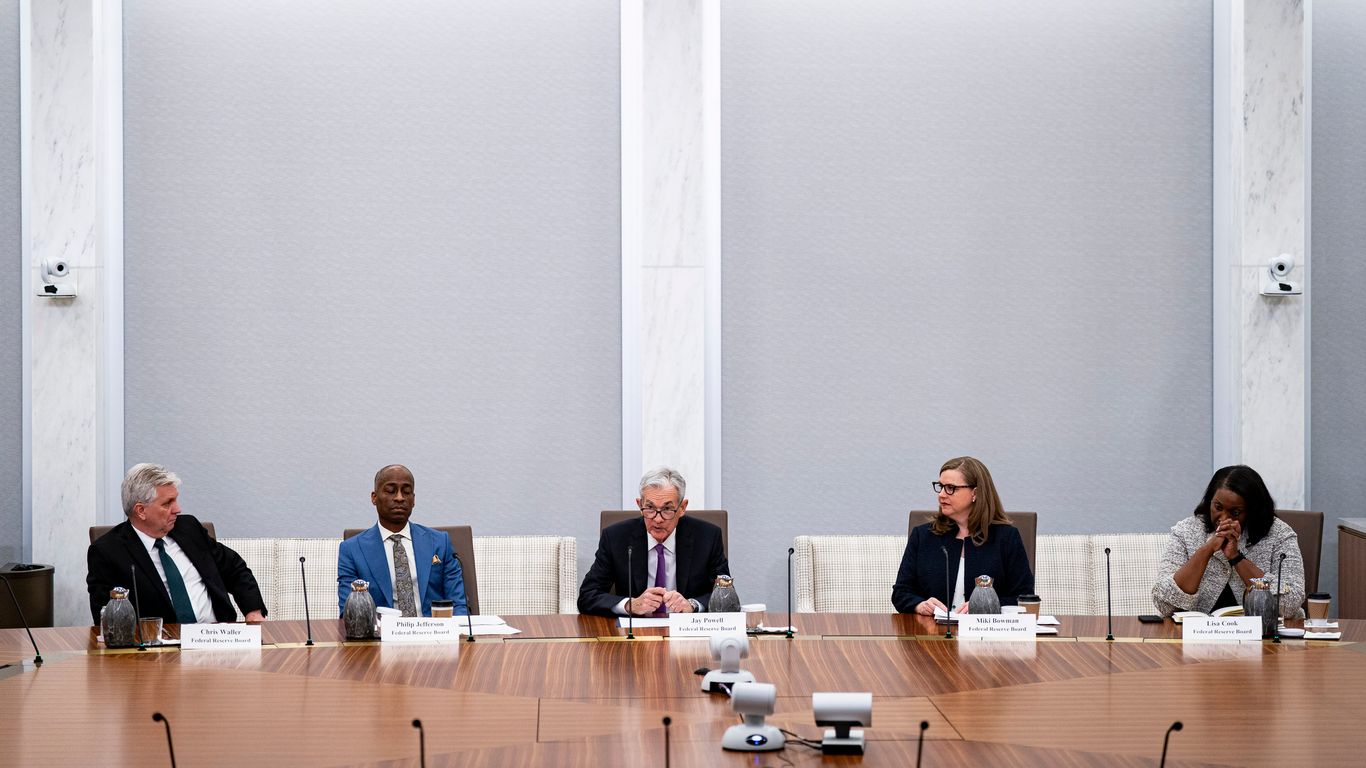
The Fed is narrowly split over a potential rate cut next month: Chair Jerome Powell, Vice‑Chair Philip Jefferson and NY Fed President John Williams would likely be joined by three Trump‑appointed governors (Michelle Bowman, Stephen Miran and Christopher Waller) for six of 12 FOMC votes, leaving the committee one vote short of a majority. All four voting regional presidents (Austan Goolsbee, Susan Collins, Alberto Musalem and Jeff Schmid) have expressed reservations and Biden‑appointed governor Michael Barr appears inclined to err on the side of caution, making Lisa Cook the plausible swing vote — a dynamic complicated by a Supreme Court hearing on Jan. 21 over President Trump’s attempt to remove her. The arithmetic and legal uncertainty around Cook elevate policy risk and make the outcome of any near‑term cut materially less certain for markets.
The Federal Reserve appears narrowly split on a potential rate cut next month: Chair Jerome Powell, Vice‑Chair Philip Jefferson and NY Fed President John Williams would likely be joined by three Trump‑appointed governors (Michelle Bowman, Stephen Miran and Christopher Waller) for six of 12 FOMC votes, leaving the committee one vote short of a majority. That arithmetic makes the identity of a seventh vote decisive for whether a cut is approved at the meeting.
All four voting regional presidents at this meeting (Chicago’s Austan Goolsbee, Boston’s Susan Collins, St. Louis’ Alberto Musalem and Kansas City’s Jeff Schmid) have publicly expressed reservations about cutting rates, increasing the probability of dissent among presidents and reducing the pool of reliable yes votes; Goolsbee has been explicitly noncommittal. Among Biden‑appointed governors, Michael Barr is described as inflation‑worried and likely cautious, whereas Lisa Cook is presented as the plausible swing voter whose stance has been kept close to the vest.
Legal uncertainty compounds the vote calculus: the Supreme Court is scheduled to hear the case on Jan. 21 regarding President Trump’s attempt to remove Governor Cook, creating a potential governance shock that could influence voting dynamics or market perceptions immediately before or after the decision. External signals flag mild negative sentiment and a market impact score of 0.32, indicating elevated near‑term policy risk and likely volatility in rate‑sensitive assets and policy‑priced instruments.
Investors should treat the outcome as materially uncertain until the vote tally and the Jan. 21 hearing are resolved, and expect short‑term swings in Fed funds expectations and interest‑sensitive sectors as the committee’s internal arithmetic and legal timeline play out.
AI-powered research, real-time alerts, and portfolio analytics for institutional investors.
Request DemoOverall Sentiment
mildly negative
Sentiment Score
-0.25
