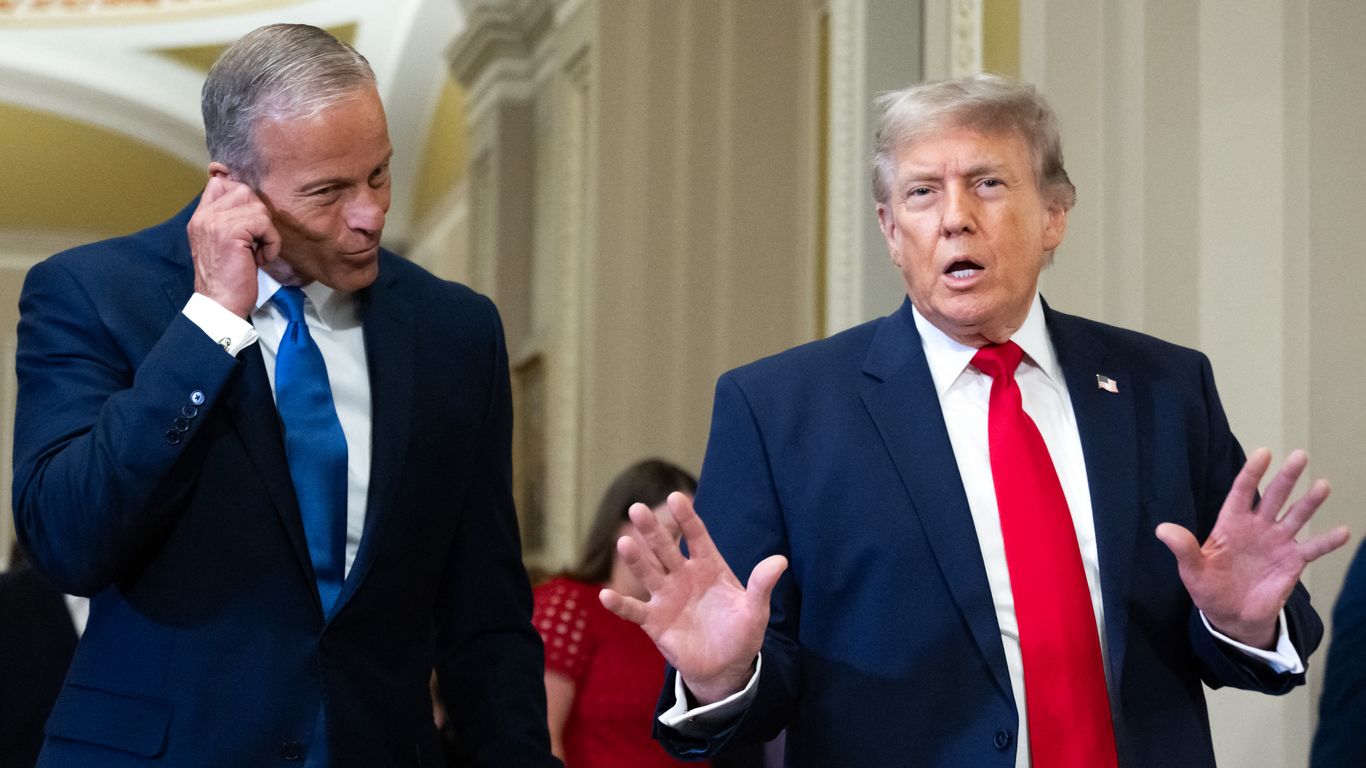
Trump's lunch with GOP senators was dominated by a shouting match over Iran, the war powers resolution, and demands to eliminate the filibuster, with little progress on the SAVE America Act or a bipartisan housing bill. Cassidy publicly criticized the administration's lack of transparency on the Iran operation, while Trump pressed senators to back his agenda and criticized defectors on the war powers vote. The meeting underscores intra-party conflict and policy uncertainty, but it does not present an immediate direct market catalyst.
The immediate market read is not about one shouting match; it is about the widening gap between executive signaling and congressional execution risk. That creates a short-term premium for firms exposed to discretionary defense funding, sanctions enforcement, and Middle East logistics because the administration is still trying to keep geopolitical optionality high while the Senate is moving in the opposite direction. The second-order effect is that the longer this friction persists, the more likely the White House leans on non-legislative tools, which tends to favor contractors and advisory-heavy defense names over pure policy-beta trades. The filibuster/voter-ID push is more interesting for the election/infrastructure complex than for headline politics. If leadership cannot convert presidential pressure into floor action, the near-term beneficiary is status-quo governance: housing, permitting, and budget negotiations stay in a muddle, which generally supports larger incumbents with lobbying scale and hurts rate-sensitive cyclicals that need legislative certainty. Over the next 1-3 months, the key catalyst is whether the party leadership can package a narrower deal; failure would increase the odds of further intraparty volatility and make “must-pass” vehicles more vulnerable to sudden amendments. Contrarian angle: the market may be underpricing how quickly this kind of public conflict can reduce policy throughput without changing stated policy goals. That is bearish for any trade that depends on clean implementation of the Iran deal or a fast legislative win, but bullish for volatility itself because the gap between rhetoric and process typically widens into the next funding and foreign-policy inflection point. The event risk is not a day-trade headline; it is a multi-week drift toward lower legislative credibility, which tends to compress consensus probabilities and increase dispersion across government-exposed sectors.
AI-powered research, real-time alerts, and portfolio analytics for institutional investors.
Request DemoOverall Sentiment
neutral
Sentiment Score
-0.10
