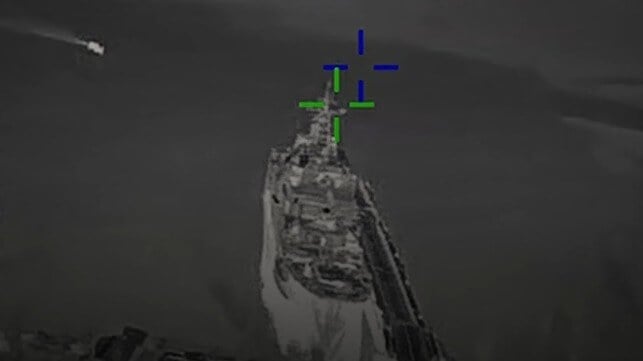
Ukraine struck two Russian landing ships moored at Sevastopol overnight, hitting the Yamal and Nikolay Filchenkov and also destroying a reported $5 million Podlyot-K1 radar system. The damage assessment is still pending, but the attack underscores continued pressure on Russia's Black Sea fleet and its military logistics, especially after Ukraine disabled the Kerch Strait rail ferry service. The article also highlights escalating Ukrainian attacks on Russian oil export infrastructure, including repeated strikes on the Tuapse oil terminal.
The more important market signal is not the maritime strike itself, but the continued degradation of Russia’s logistics redundancy. When rail-linked throughput is disrupted and sea lift becomes less reliable, the bottleneck shifts from transport capacity to inventory positioning, which tends to increase volatility in regional fuel availability and military supply flows before it shows up in headline export figures. That creates a lagged risk premium for Black Sea-adjacent energy logistics rather than an immediate broad commodity shock. The second-order winner is anything that benefits from tighter Russian product routing and more expensive insurance/security layers: alternative crude/product exporters, non-Russian tanker routes, and port/terminal hardening vendors. The loser set is broader than Russian naval assets; repeated strikes force defensive dispersion, which raises operating costs and reduces effective utilization across both military and civilian infrastructure. Over a 1-3 month window, the more actionable issue is not tonnage lost in a single attack, but the compounding effect on turnaround times, repair capex, and route substitution. Consensus may be underpricing the asymmetry between headline damage and operational disruption. These kinds of attacks often do not need to permanently destroy assets to be effective; forcing ships and terminals into a heightened state of readiness can reduce throughput and increase idle time even if physical damage is moderate. The contrarian risk is that markets overreact to each strike individually while underestimating Russia’s ability to reroute flows and repair quickly, which could cap any sustained move in oil unless attacks broaden to higher-leverage nodes. The cleanest trade is to express a modest bullish bias on non-Russian energy logistics and defense-related industrials rather than a directional crude spike. If the attack cadence persists for several weeks, the market should start pricing a higher geopolitical friction premium into regional shipping and insurance, but not necessarily a durable global oil shortage. That argues for relative-value positions over outright commodity longs unless escalation spreads to export terminals with direct barrels at risk.
AI-powered research, real-time alerts, and portfolio analytics for institutional investors.
Request DemoOverall Sentiment
mildly negative
Sentiment Score
-0.20
