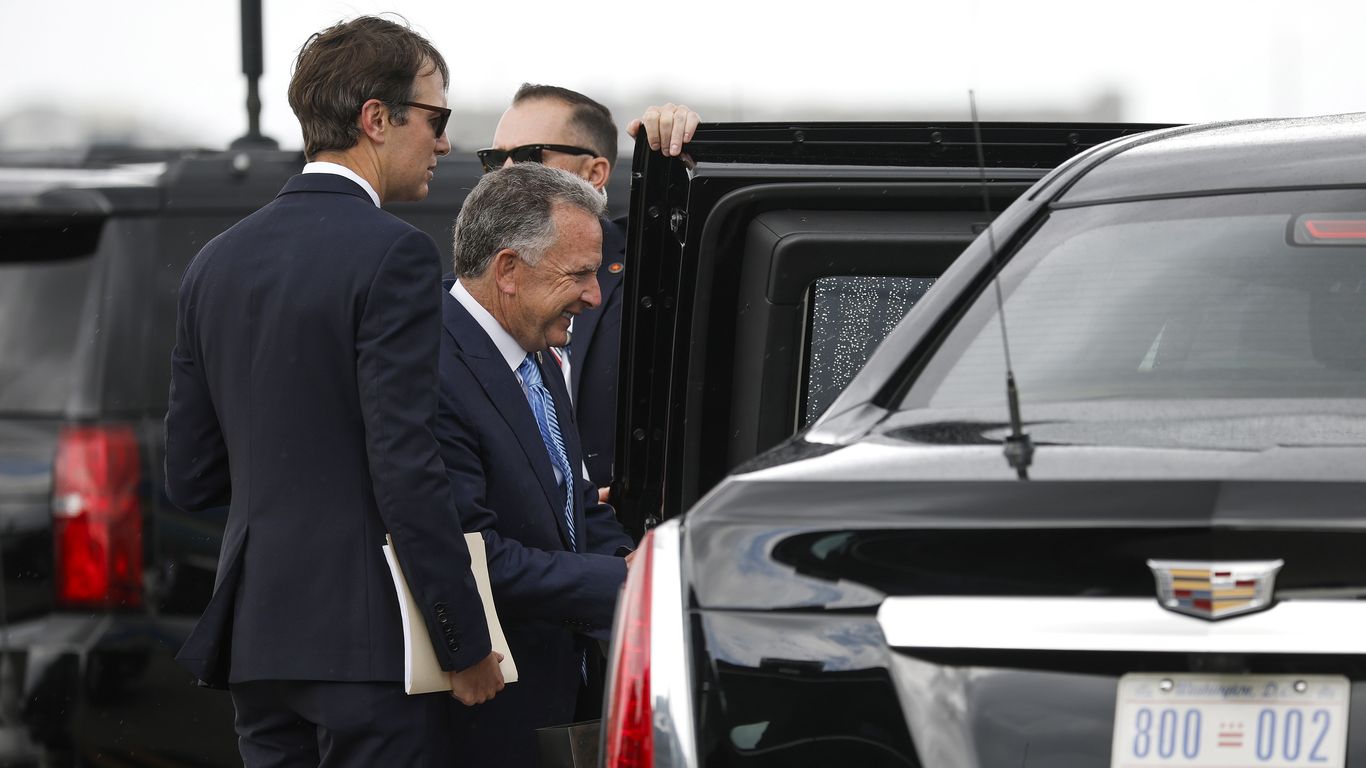
U.S. and Ukrainian delegations are meeting in Miami to finalize a revised U.S. peace plan ahead of envoys Steve Witkoff and Jared Kushner presenting it to Vladimir Putin in Moscow, with diplomacy focused on territory and security guarantees. Ukraine's lead negotiator Andriy Yermak resigned after an anti-corruption raid, shifting the delegation to national security adviser Rustem Umerov and raising political uncertainty in Kyiv; the U.S. team includes Secretary of State Marco Rubio. Key risks remain: Kyiv has secured edits to the original 28-point plan, the Kremlin has signaled resistance and amplified territorial demands, and outstanding gaps on territory and security could keep markets cautious, especially in defense, energy and EM assets.
Market structure: Short-term winners are defense primes (LMT, RTX, NOC) and commodity producers (XOM, CVX, XLE, GLD) if talks fail or re-escalation occurs; losers include European gas importers, Ukrainian assets and airlines (DAL, AAL) due to higher fuel/route risk. Pricing power for defense contractors increases if U.S. Congress ties aid to formal security guarantees — expect FY2026+ backlog expansion of 5–15% consensus if a ceasefire is not durable. Safe-haven flows will bid USTs and USD; a 25–50 bps move in 10y yields is plausible intra-week around geopolitical headlines.
Risk assessment: Tail risks include a sudden major offensive (monthly probability 10–20%) that spikes Brent >$90 within 2–6 weeks and VIX +40%; alternatively, a negotiated settlement could compress defense multiple by 10–20% over 3–6 months. Hidden dependencies: U.S. domestic politics (aid approvals tied to midterms/election cycles) and the Yermak corruption probe could reduce Ukraine’s negotiating flexibility, changing the probability of ceasefire vs protracted war. Key catalysts are the Miami talks (now), Kushner/Witkoff visit to Moscow (Tue), and any joint communique — treat those as event windows for 24–72 hour volatility.
Trade implications: Tactical: establish 1–3% long positions in LMT/RTX and 1–2% in GLD within 48–72 hours if no positive communique, with stop-losses at -8% and profit targets +20%/quarter. Pair trade: long LMT vs short DAL (equal notional) to isolate defense upside vs travel risk; expect spread to widen by 8–12% on escalation within 1–3 months. Options: buy 3-month 25-delta calls on LMT and 1–2 month call spreads on XLE if Brent breaches $85; alternatively buy VIX 1-month call spreads after headline-driven spikes >+20%.
Contrarian angles: Consensus assumes protracted conflict benefits defense forever; if a compromise (territory/security) is reached, defense multiples could rerate down 10–25%—short catalysts include any bilateral Putin–Zelensky announcement. Markets may be underpricing political risk inside U.S. (aid conditionality); a sudden U.S. funding cutoff would be a fast, non-linear negative for U.S. defense order book estimates. Historical parallels: 2014 Crimea/Donbas shows defense stock pops but long-term mean reversion; avoid levering defensives beyond 3% notional until 90 days post any formal ceasefire.
AI-powered research, real-time alerts, and portfolio analytics for institutional investors.
Request DemoOverall Sentiment
moderately negative
Sentiment Score
-0.45
