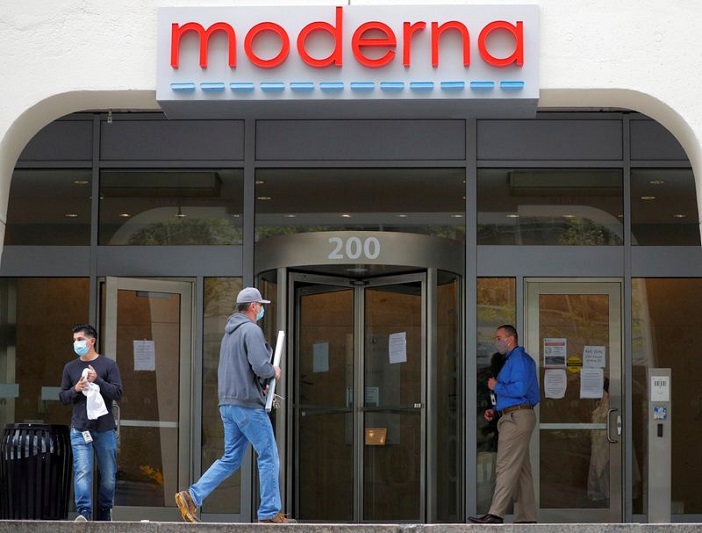
Moderna President Stephen Hoge sold 53,336 shares at $48.40 per share for about $2.58 million, after exercising the same number of options at $19.15 per share. The buy and sale were both executed under a Rule 10b5-1 plan, and Hoge still directly holds 1,477,997 shares plus additional indirect stakes. The article also highlights Moderna’s bylaws amendment on Securities Act venue selection and ongoing mRNA vaccine research, but the core new information is the routine insider transaction.
The market is still treating Moderna like a single-asset vaccine story, but the more important signal is that the equity is now trading on optionality while fundamentals lag price. When a stock has doubled into a period of no expected profitability, insider monetization via a pre-set plan is less about bearish conviction and more about the equilibrium between execution risk and valuation discipline. The second-order issue is that governance and legal housekeeping reduce some overhangs, but they do not create near-term cash flow, so the stock remains highly sensitive to any disappointment in pipeline cadence.
The real catalyst path is binary and time-discounted: if the mRNA platform produces one or two credible non-COVID catalysts over the next 6-12 months, the market can justify the rerating; if not, multiple compression can be violent because there is no earnings anchor to defend the move. That makes Moderna vulnerable to a “good news fatigue” setup where incremental announcements fail to add marginal value. Competitively, the bigger winners are likely platform peers and contract-biotech names that can absorb risk capital if MRNA stalls, while vaccine incumbents may face less relative scrutiny if investor attention shifts away from one-name momentum.
Contrarian read: the stock may be over-owned by investors extrapolating the last year’s tape rather than underwriting a sustainable earnings bridge. The insider transaction itself is low-signal because it was mechanically hedged by the same-day option exercise and executed under a trading plan, but it reinforces that insiders are willing to diversify into strength. The asymmetry is now skewed toward downside if the broader biotech factor turns risk-off, because a high-valuation, no-profit name with elevated expectations tends to underperform first in a sector de-rating.
AI-powered research, real-time alerts, and portfolio analytics for institutional investors.
Request DemoOverall Sentiment
neutral
Sentiment Score
0.08
Ticker Sentiment
