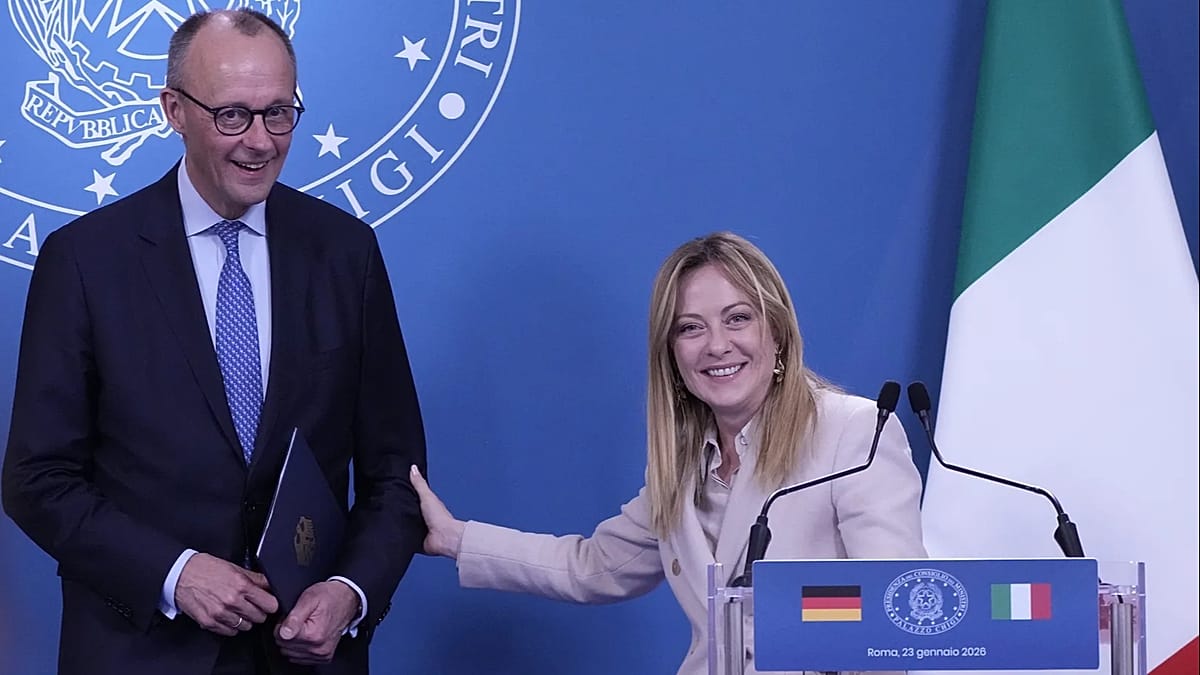
Ahead of an EU leaders' retreat in Alden Biesen, France is clashing with a newly aligned Germany and Italy over how to revive the bloc’s competitiveness — Paris is pushing for pooled EU debt (eurobonds) to help finance what Draghi estimated as €750–800bn a year of investment needs and for a limited "European preference" in public procurement, while Berlin and Rome favour deregulatory measures, expanded venture-capital financing, a pan‑European stock exchange/secondary market and time‑limited procurement rules. The debate also touches the provisional implementation of the Mercosur trade deal, with France opposed and Italy supportive, and Commission chief von der Leyen focusing on cutting red tape rather than joint borrowing; outcomes will influence sovereign issuance, capital-market development and sectoral protectionism across the EU.
Market structure: A Franco vs Berlin-Rome split reweights winners toward German/Italian industrials, financials and pan‑EU infrastructure (exchanges, clearing, VC platforms) if deregulatory + market-integration wins; French agriculture, some CAC40 domestics and trade-exposed exporters are clear losers if European preference and Mercosur fall through. The €750–800bn/yr investment gap cited implies sustained elevated demand for growth capital—if no joint issuance, expect private markets and bank lending to capture 50–70% of that incremental demand, lifting valuations in listed private-equity/VC-like vehicles.
Risk assessment: Tail risks include (A) political fragmentation leading to a >100bp widening of Italy–Germany 10y spreads within 3–6 months, and (B) rapid fiscal integration (joint issuance) compressing peripheral spreads by 30–80bps in 1–3 months. Hidden dependencies: ECB balance-sheet reaction, national elections, and US/China tech moves; catalysts are the Alden Biesen communiqué language (explicit "common issuance" vs "no joint borrowing") and a Commission 28th-regime draft within 30–90 days.
Trade implications: If Berlin/Rome deregulatory agenda prevails, favor long Deutsche Börse (DB1.DE) and Euronext (ENX.PA) 3–9 month calls and EU bank exposure (EUFN) as lending improves; if Macron wins eurobond traction, rotate into Italian sovereigns (long BTP vs short Bund). Use volatility trades: buy 1‑month EURUSD straddle around the summit (target vega) and buy 3–6 month protection (5y CDS) on Italian sovereigns if communique excludes joint debt.
Contrarian angles: Consensus focuses on eurobonds vs deregulation as binary; underappreciated is a hybrid outcome—limited, sectoral EU co-financing (clean tech/defence) combined with deregulatory capital markets reforms—which would boost listed defense/clean-tech names (Thales HO.PA, Leonardo LDO.MI, Umicore UMI.BR) while leaving broad sovereign spreads rangebound. Market may underprice the probability (20–35%) of targeted joint issuance for strategic sectors over 12 months—trade accordingly.
AI-powered research, real-time alerts, and portfolio analytics for institutional investors.
Request DemoOverall Sentiment
neutral
Sentiment Score
-0.15
